 ▶
▶
 ▶
▶Destination Wedding Planner
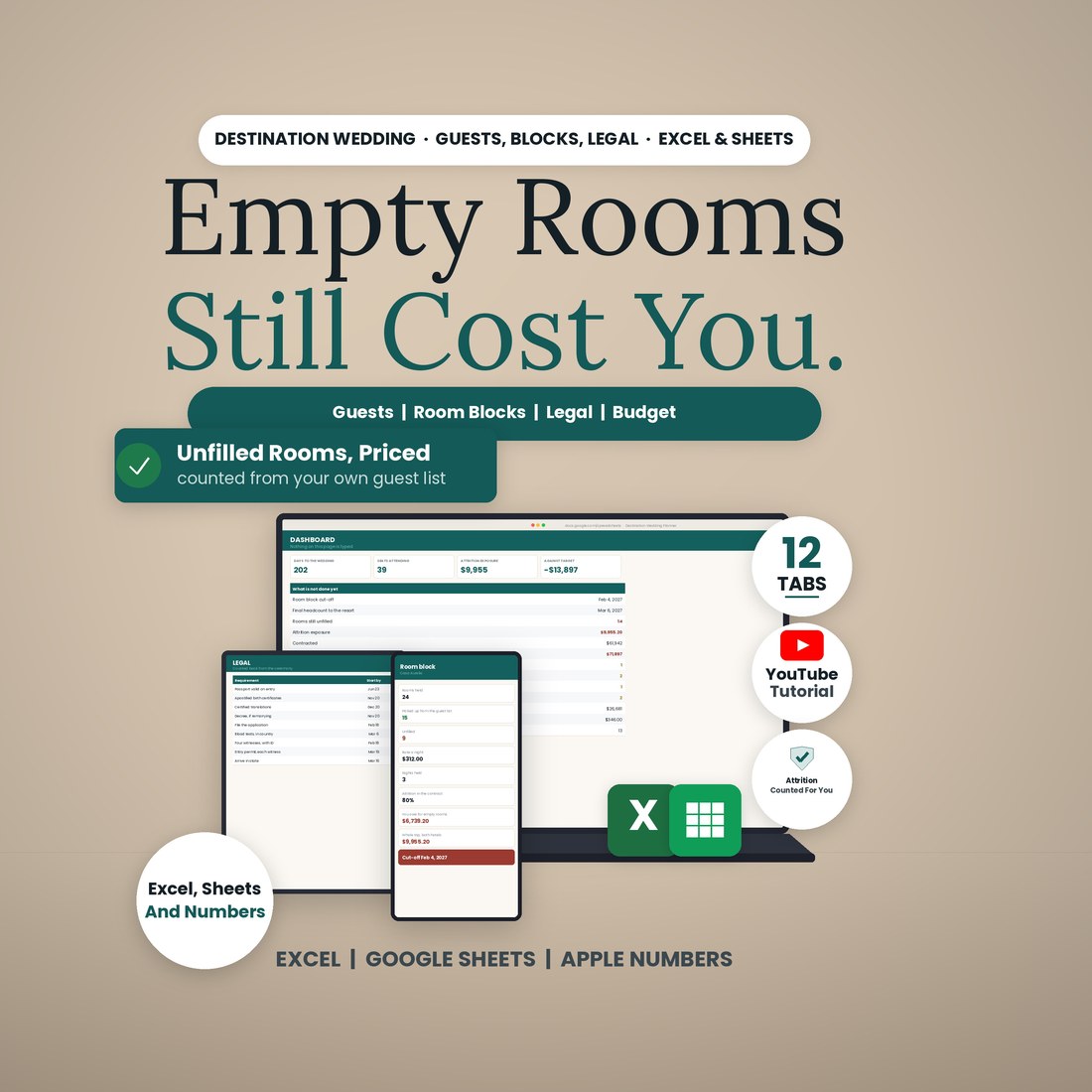
Empty rooms still cost you. This one counts them.
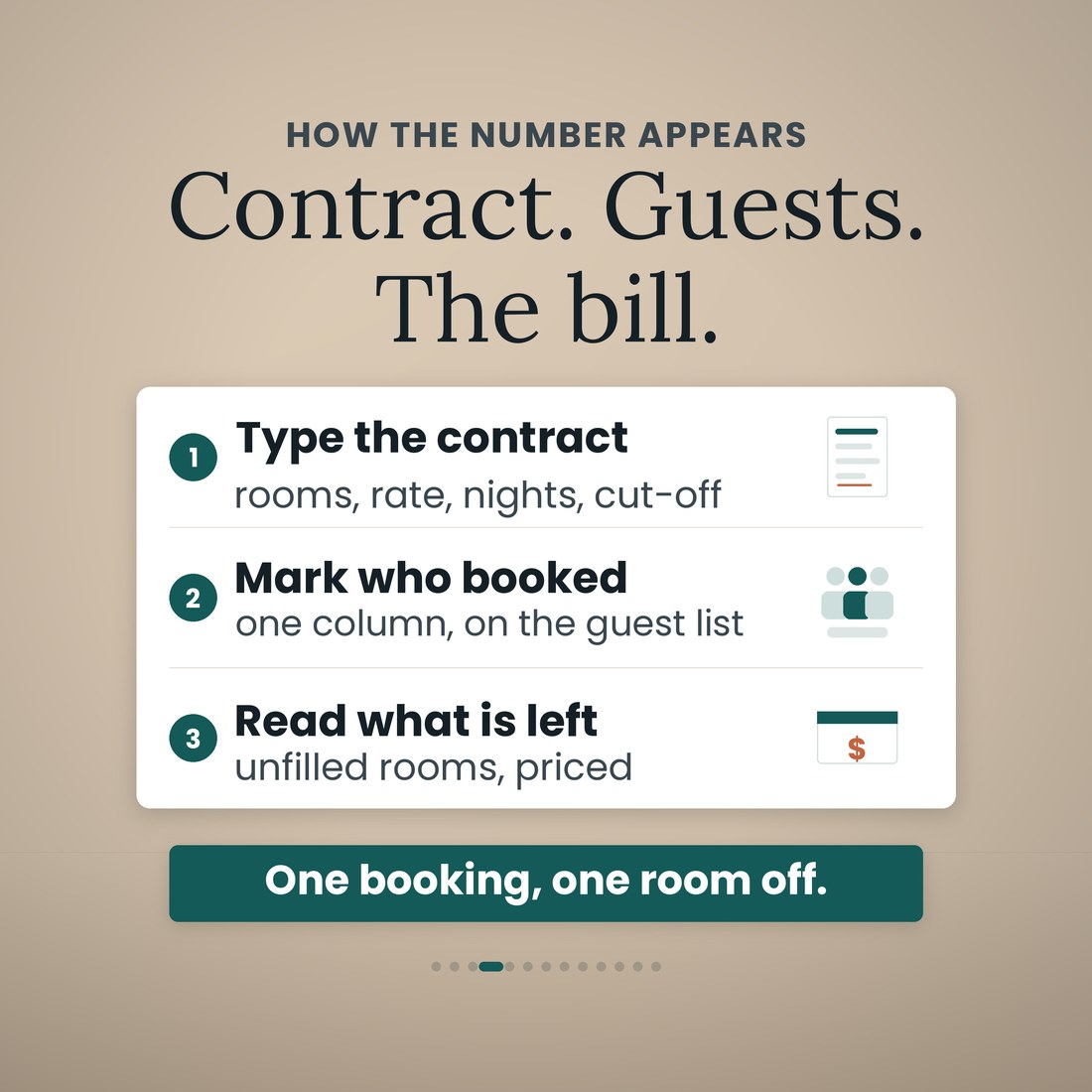
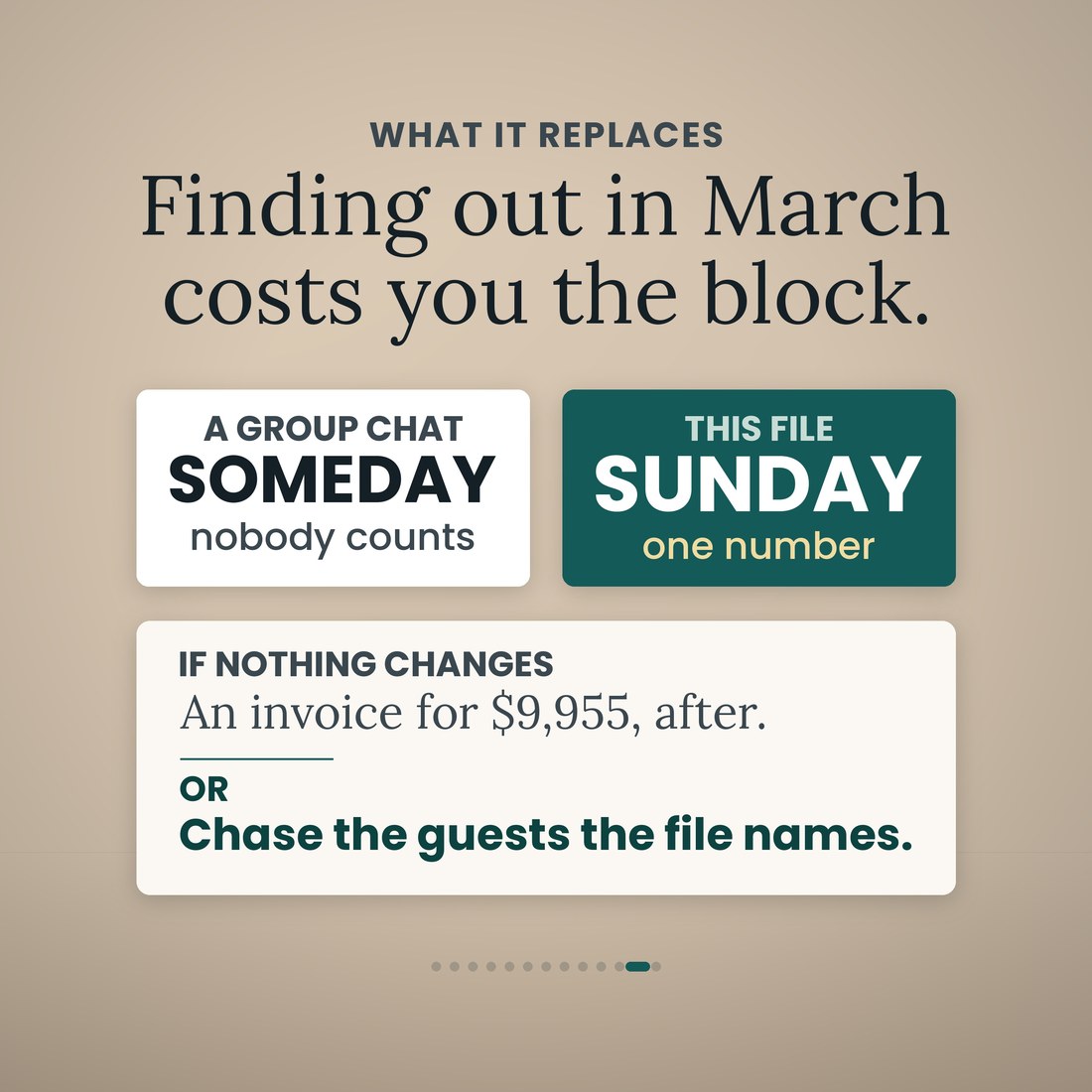
You signed a contract for twenty-four rooms. Somewhere in it is a clause saying that the ones nobody books get billed back to you, and almost nobody reads that clause before signing it. Eleven months out you have a guest list in one app, a resort contract as a PDF attachment, passport photos in a group chat, and no single number telling you what any of it will cost. This file makes that number. You type the resort contract once, and from then on the rooms picked up are counted out of your own guest list, so the money you owe on empty rooms falls by one room every time a guest books. Nothing about it is a guess and none of it is typed twice.
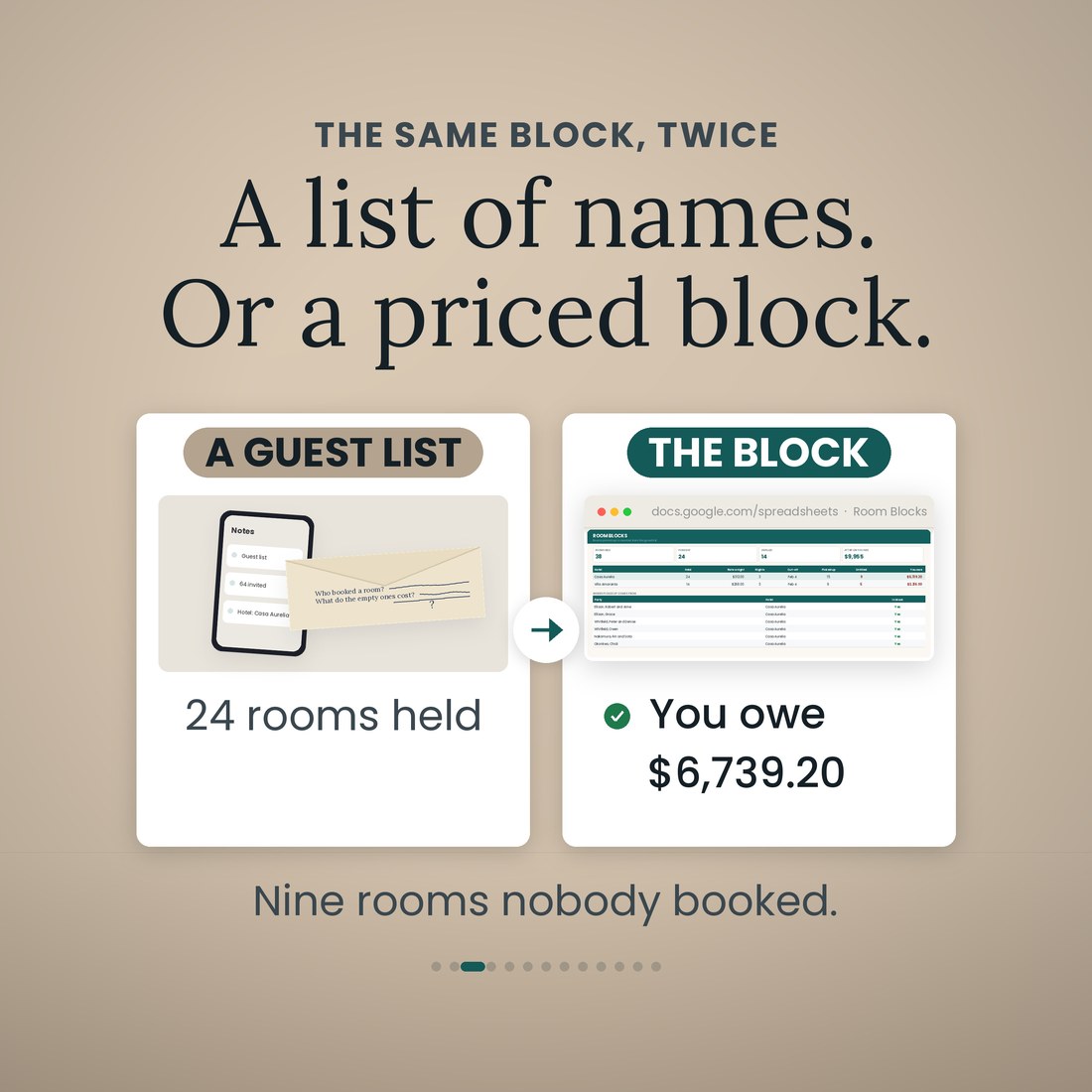
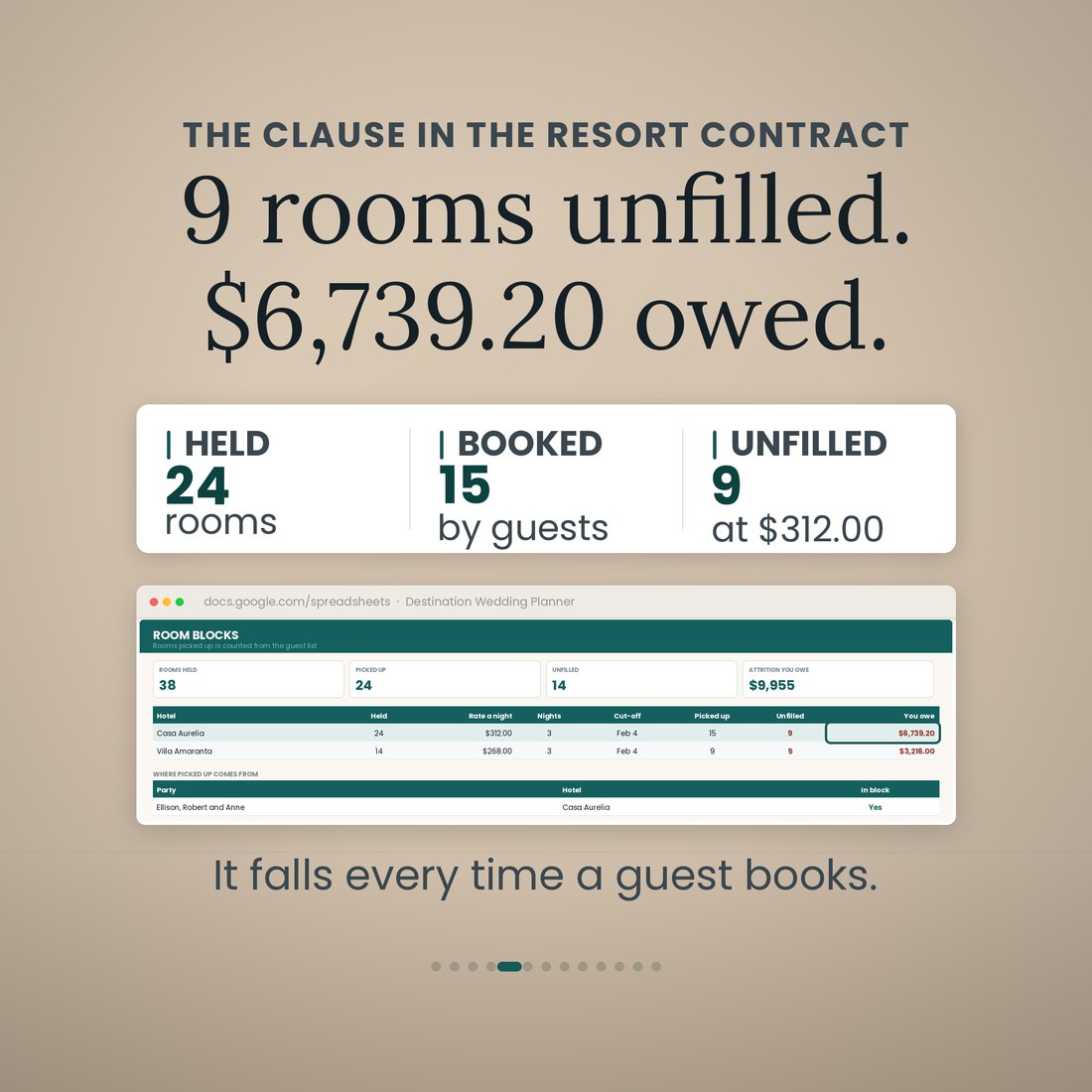
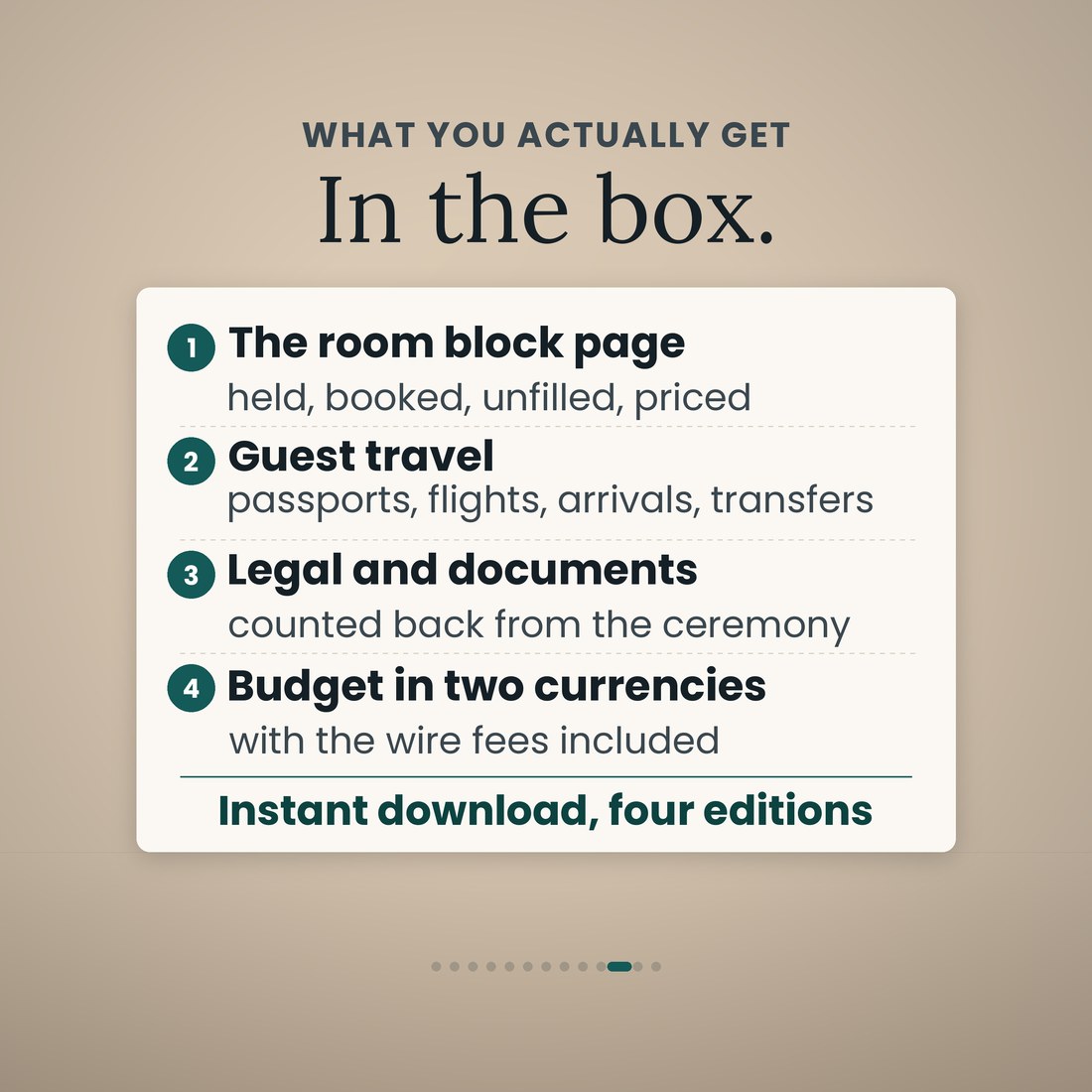
- Room Blocks: type the resort contract once — rooms held, nightly rate, nights, cut-off date and the attrition percentage — and rooms picked up is never typed. It is counted out of the Guest Travel tab, so unfilled rooms and the money they cost fall by one room every time a guest books. In the worked sample Casa Aurelia holds 24 rooms against 15 booked, and 9 unfilled rooms at $312.00 a night for 3 nights on an 80 percent clause is $6,739.20 owed at that hotel and $9,955.20 across both
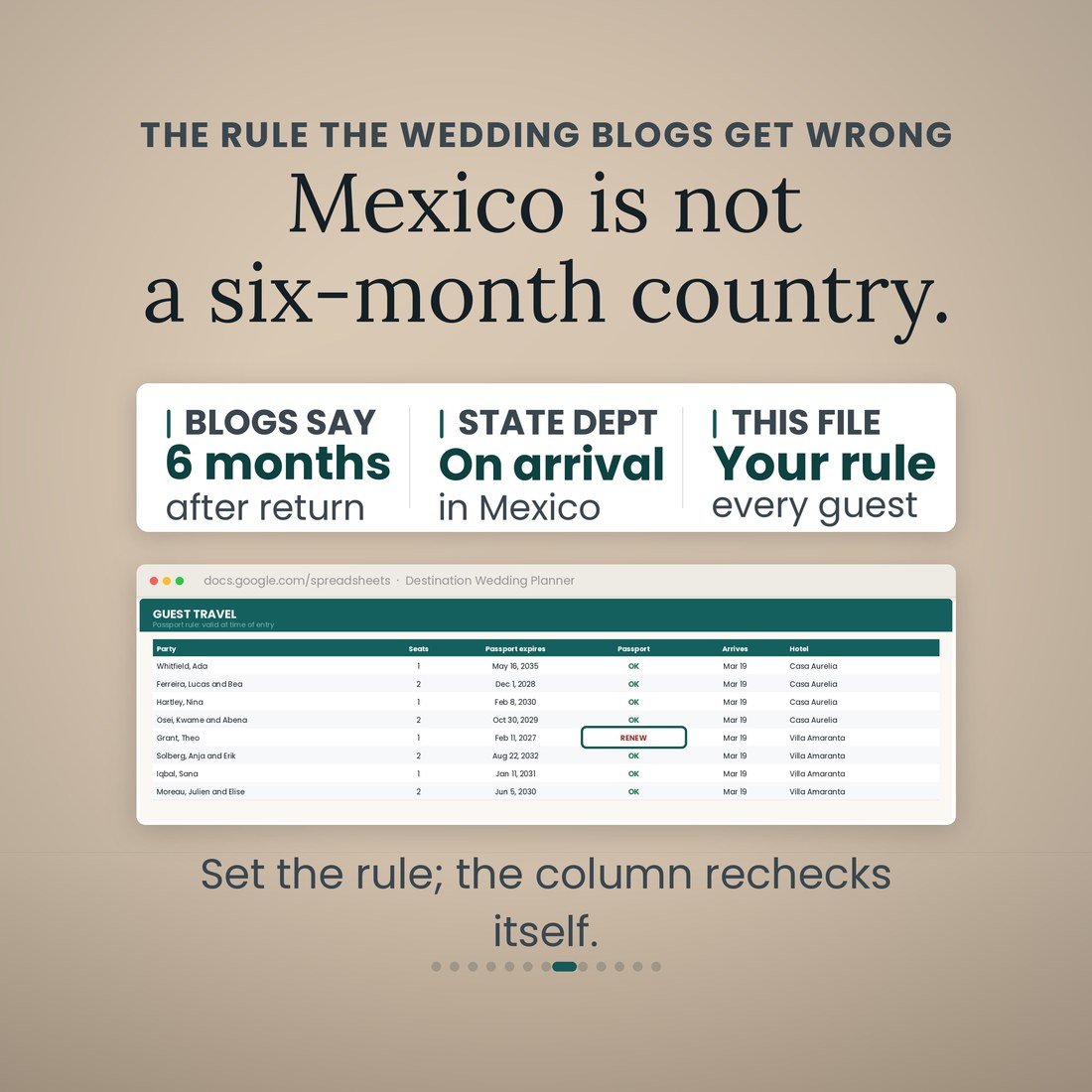
- Passports checked against the rule that actually applies. Nearly every wedding site says six months beyond your return; for Mexico the U.S. State Department country page says valid at the time of entry. Because the correct rule genuinely differs by country it is a setting, not a hard-coded number — pick valid at entry, 3 months beyond return or 6 months beyond return and every guest re-flags against their own return date
- Legal, counted back from the ceremony: ten requirements, each with a lead time you can change, each turned into a start-by date and days remaining — apostilled birth certificates, certified translations, the marriage application, blood tests taken in country inside the 14-day window, four witnesses with their own travel documents, and the business days you must be in state before the civil ceremony
- Guest Travel and Arrivals: one row per invited party carrying seats, RSVP, passport expiry and its own flag, visa, flights, arrival and departure, hotel, in-block, transfer, welcome bag and dietary notes — then who lands on which day, grouped into vans at your van size, with the transfer cost and the seats that have no transfer booked at all
- Budget in both currencies at the rate you set, Payments with due dates, days remaining and the international wire fee so the total out is what really leaves your account, an Itinerary that re-dates itself when the wedding date moves, Welcome Bags costed ship-it-or-buy-it-there with freight and duty, and a 22-task Timeline counted in months back from the date
Overview
Empty rooms still cost you. This one counts them.
You signed a contract for twenty-four rooms. Somewhere in it is a clause saying that the ones nobody books get billed back to you, and almost nobody reads that clause before signing it. Eleven months out you have a guest list in one app, a resort contract as a PDF attachment, passport photos in a group chat, and no single number telling you what any of it will cost. This file makes that number. You type the resort contract once, and from then on the rooms picked up are counted out of your own guest list, so the money you owe on empty rooms falls by one room every time a guest books. Nothing about it is a guess and none of it is typed twice.
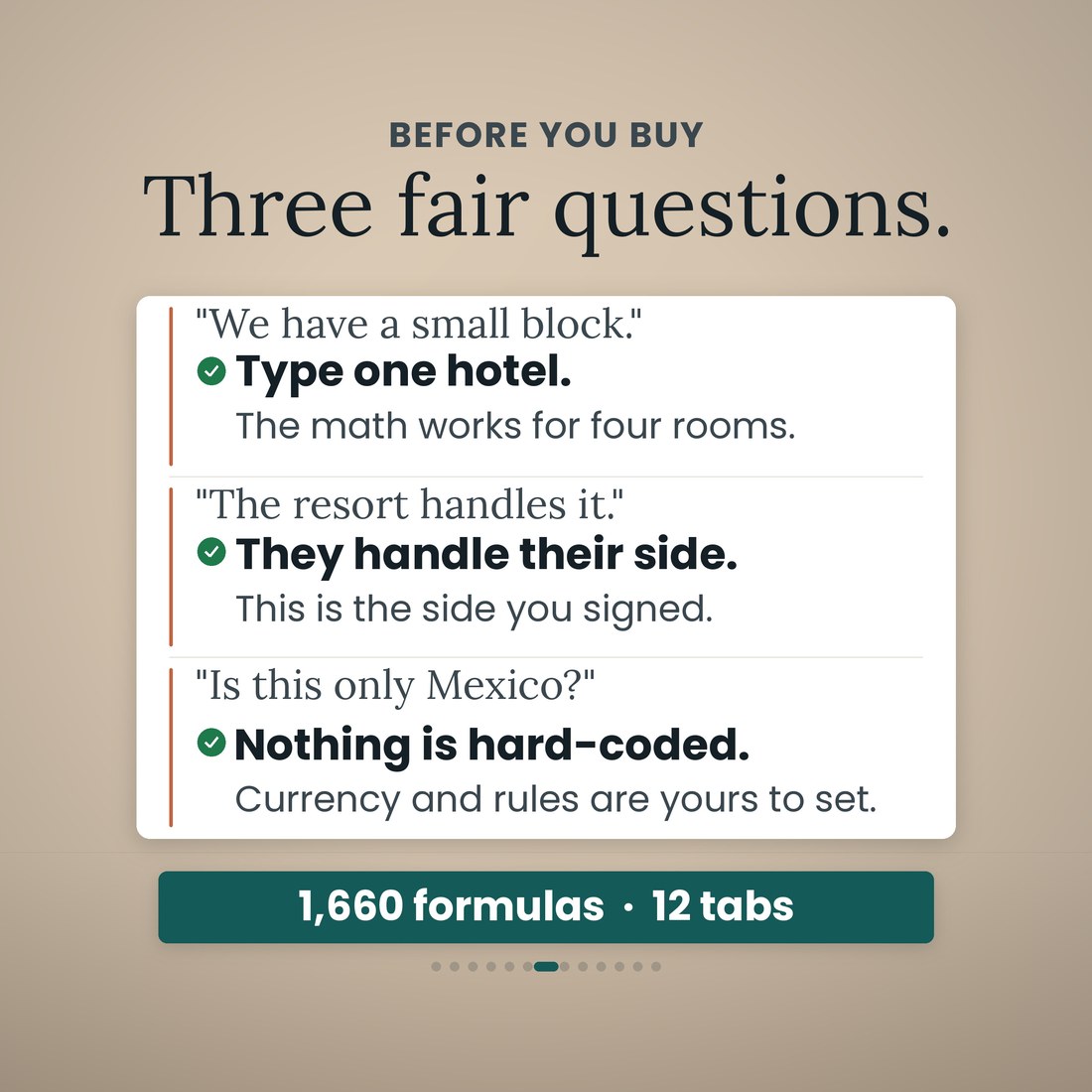
It is one workbook with 12 tabs and 1,660 live formulas, and it opens the same way in Microsoft Excel, Google Sheets and Apple Numbers, because every formula uses the portable function set — no macros, no add-ons, no account and nothing to install. You type into the cream cells only: your date and destination once, the resort contract once per hotel, one row per invited party, and your payments as they are agreed. Rooms picked up, unfilled rooms, the money owed on them, every passport flag, the arrival groupings, the transfer cost, the landed cost per welcome bag, the legal start-by dates and the whole weekend itinerary are read, never typed. A worked sample ships inside — Maya Ellison and Daniel Whitfield, married at a resort in Playa del Carmen, Quintana Roo, Mexico on Saturday 20 March 2027, 32 invited parties and 48 seats, two hotels holding 38 rooms, a full budget in dollars and pesos and a full legal checklist — so every tab has something to show on open. Type over any of it and the formulas stay.
What's Included
One workbook, 12 tabs, in four color editions:
- Destination-Wedding-Planner.xlsx: the 12-tab workbook with 1,660 formulas, opening in Microsoft Excel, Google Sheets and Apple Numbers
- The same workbook in four color editions — Colorful, Light, Dark and Editorial — every one doing the same arithmetic
- A worked sample book inside: a March 2027 wedding in Playa del Carmen with 32 invited parties, 48 seats, two hotels holding 38 rooms, 12 budget categories, 18 scheduled payments and a full legal checklist, so every tab works on open
- The Room Blocks page that prices your attrition clause from your own guest list, and re-prices it every time somebody books
- A full narrated video walkthrough on YouTube, every screen the real file, linked in the workbook and on your confirmation page
- Five .xlsx files in one ZIP, instant download. Nothing is shipped and there is nothing to install
Key Benefits
Why this one
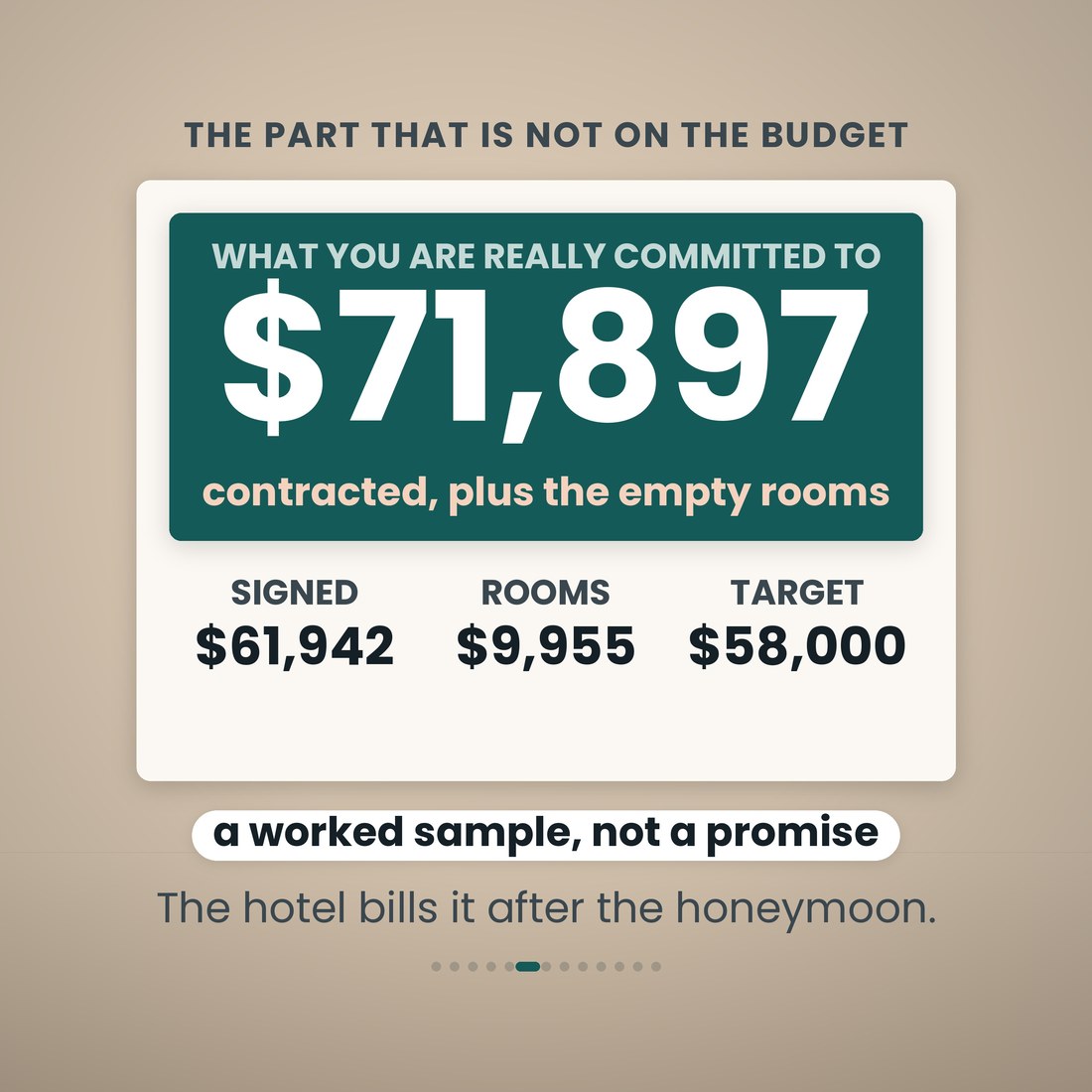
A hotel does not invoice attrition until after the honeymoon, so the money you owe on rooms nobody booked never appears until it is too late to do anything about it. Here it is a live figure. In the worked sample the two hotels hold 38 rooms, 24 are picked up, 14 are unfilled and $9,955.20 is owed — and the contracted budget of $61,942.00 becomes a true exposure of $71,897.20 against a $58,000.00 target.
This is the whole mechanism. The Room Blocks tab counts bookings out of the hotel and in-block columns on your guest list, so the moment you move one more party into the block the unfilled count drops and the money owed drops with it. In the sample, one more booking at Casa Aurelia takes 15 to 16, 9 unfilled to 8, and $6,739.20 owed to $5,990.40. Nobody has to remember to update a second number, because there is no second number.
Nearly every wedding blog tells you a passport must be valid six months beyond your return. For Mexico the U.S. State Department country page says valid at the time of entry. Rather than hard-code either one, the passport rule is a setting: choose valid at entry, 3 months beyond return or 6 months beyond return, and every guest's OK or RENEW flag recalculates against that guest's own return date.
The itinerary, the 22-task timeline and the ten legal start-by dates are all counted from the wedding date on Setup rather than typed in. Change that one cell and every deadline moves with it. Nine of the 22 timeline tasks exist only because the wedding is abroad, which is exactly the set a domestic checklist leaves out.
Payments carries deposits and finals with due dates, days remaining, method and the international wire fee on top, because a $37,520.00 payment schedule with $346.00 of wire fees is a different number from the one on the contracts. The Budget runs in your home currency and the local one at the rate you set, so a peso quote and a dollar quote can sit in the same column.
Microsoft Excel, Google Sheets and Apple Numbers. Every formula uses the portable function set, and the workbook was recalculated in LibreOffice and then recomputed independently before shipping — 1,660 formulas and 72,644 checks across the shipping gates, zero failures. No add-ins, no macros, no login, nothing to connect and nothing to subscribe to.
Who It's For
Built for
- Couples marrying abroad who have signed, or are about to sign, a resort contract with a room block and an attrition clause in it
- Anyone whose guest list, passport photos, flight details and hotel bookings currently live across a group chat, a wedding website and a phone note
- Couples working with a local planner or a resort coordinator who want their own copy of the numbers rather than a monthly email
- Anyone who has asked what the empty rooms cost and not been able to get a straight answer out of anybody
How It Works
Up and running in minutes
Your wedding date, the destination, your home and local currency with the exchange rate, the passport rule for that country, the block cut-off and the final headcount date. Once, on Setup.
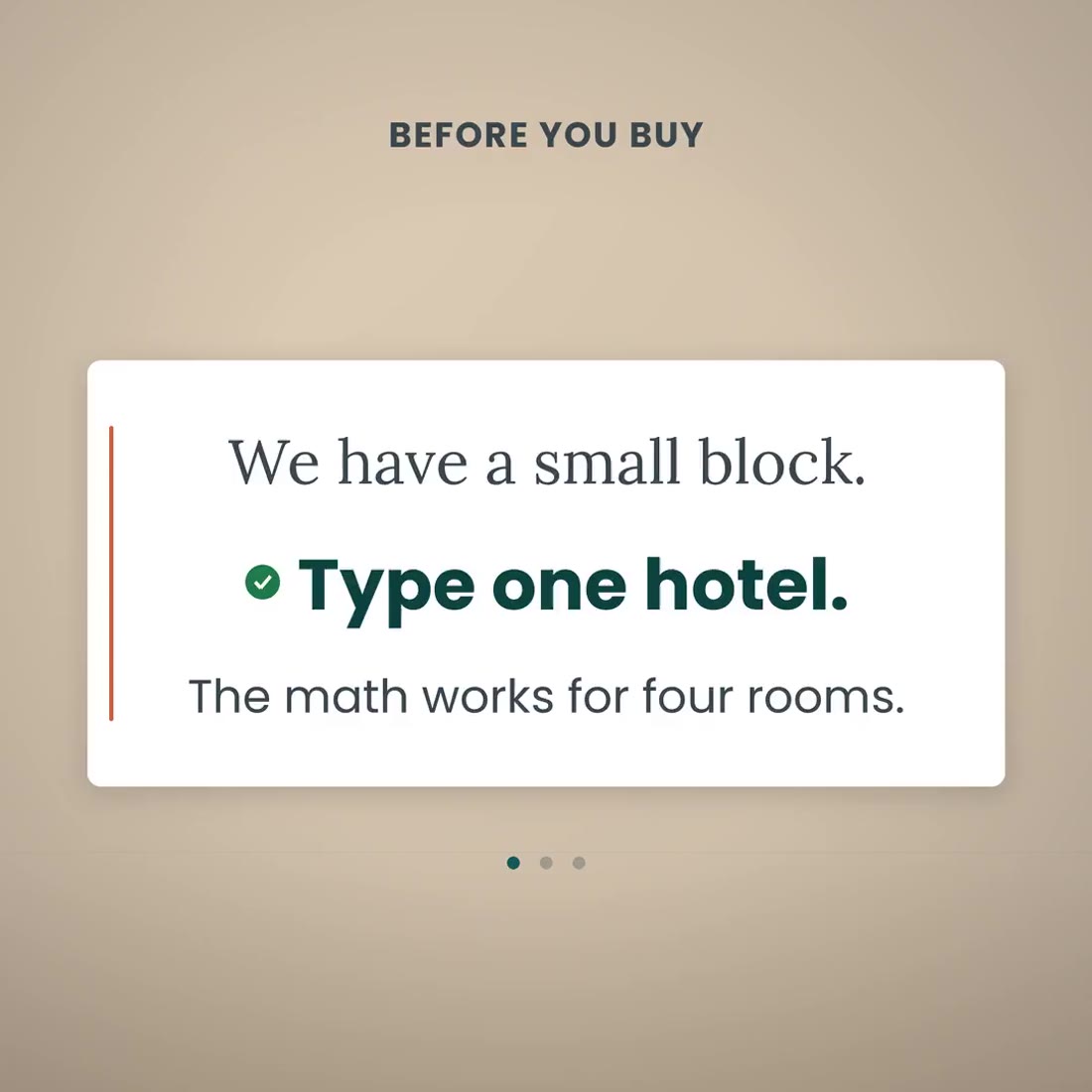
Rooms held, the nightly rate, the number of nights, the cut-off date and the attrition percentage, straight off the contract. This is the only place those numbers go.
Seats, RSVP, passport expiry, visa, flights, arrival and departure, which hotel and whether they are in the block. The passport flag and the room block arithmetic both feed off this one tab.
Every budget line in both currencies, deposits and finals with their due dates and wire fees, the welcome bags, and the itinerary — which dates itself from the wedding date, so moving the date moves the weekend.
Who has replied, whose passport needs renewing, who has no flights, what you are truly committed to, and how many rooms are still unfilled at what cost. Check it after every booking; the number moves.
Why It's Different
Not another template
Most destination wedding planners are a pretty PDF or a Canva template with a checklist on it. This is a working file, and it does the three jobs a wedding abroad actually turns on. First, it prices your room block. You promised the resort a number of rooms, unfilled ones are billed back to you at a percentage — 80 percent is common and 100 percent exists — and that clause is the single biggest unpriced number in a destination wedding. Type the contract once and rooms picked up is never typed: it is counted out of your own guest list, so 24 rooms held against 15 booked leaves 9 unfilled and $6,739.20 owed at $312.00 a night for 3 nights, and that figure falls by one room every time somebody books. Second, it checks every passport against the rule that actually applies rather than the six-month rule the wedding blogs repeat, because the correct rule differs by country — for Mexico the U.S. State Department country page says valid at the time of entry — so the rule is a setting and every guest re-flags against their own return date. Third, it counts ten legal requirements back from the ceremony with lead times you can change, including blood tests taken in country inside the 14-day window, four witnesses with their own travel documents, and the business days you must be in state before the civil ceremony. Around those three sit guest travel, arrivals grouped into vans, a budget in two currencies, payments with the wire fee included, welcome bags costed landed, and a 22-task timeline of which nine tasks exist only because the wedding is abroad. It is honest about its limits too. It is a planning tool and not legal advice, it does not file anything, it does not book anything, and requirements change — every line should be confirmed with the civil registry that will marry you and with the resort that holds your contract.
Delivery & Compatibility
Instant, and it opens in what you already use
As soon as your order is complete you get instant access to download the ZIP, so you can type your resort contract in tonight and see what the empty rooms are costing you before the cut-off date.
Five .xlsx workbooks (Destination-Wedding-Planner.xlsx plus the Colorful, Light, Dark and Editorial editions) delivered as one ZIP, instant download. Opens in Microsoft Excel, Google Sheets and Apple Numbers using the portable function set only — no add-ins, no macros, no login and nothing to install. The file ships with a worked sample book so every screen works on open; the images and the video show that sample. Exchange rate, passport rule, attrition percentage, van size, freight and duty rates and every legal lead time sit in editable cells for you to set and maintain. This is a digital download; nothing is shipped.
FAQ
Questions, answered
What is an attrition clause, and why does it matter this much?
When a hotel holds a block of rooms for your guests, the contract usually says that you are responsible for a percentage of the rooms nobody books. Eighty percent is common. It matters because the hotel does not invoice it until after the wedding, so it is the one large number that appears on no budget sheet until it is too late. This file keeps it in front of you the whole time, and moves it every time a guest books.
Do I have to update the room block when somebody books?
No. That is the point. You mark the guest's hotel and tick that they are in the block on the guest list, which you were going to do anyway, and the Room Blocks tab counts it. Rooms picked up, rooms unfilled and the money owed all move on their own.
Is this only for Mexico?
No. Nothing is hard-coded. The country, the currency and the exchange rate, the passport rule, the attrition percentage and every legal lead time are cells you set. The worked sample happens to be a Playa del Carmen wedding because it needed to be somewhere.
What are the twelve tabs?
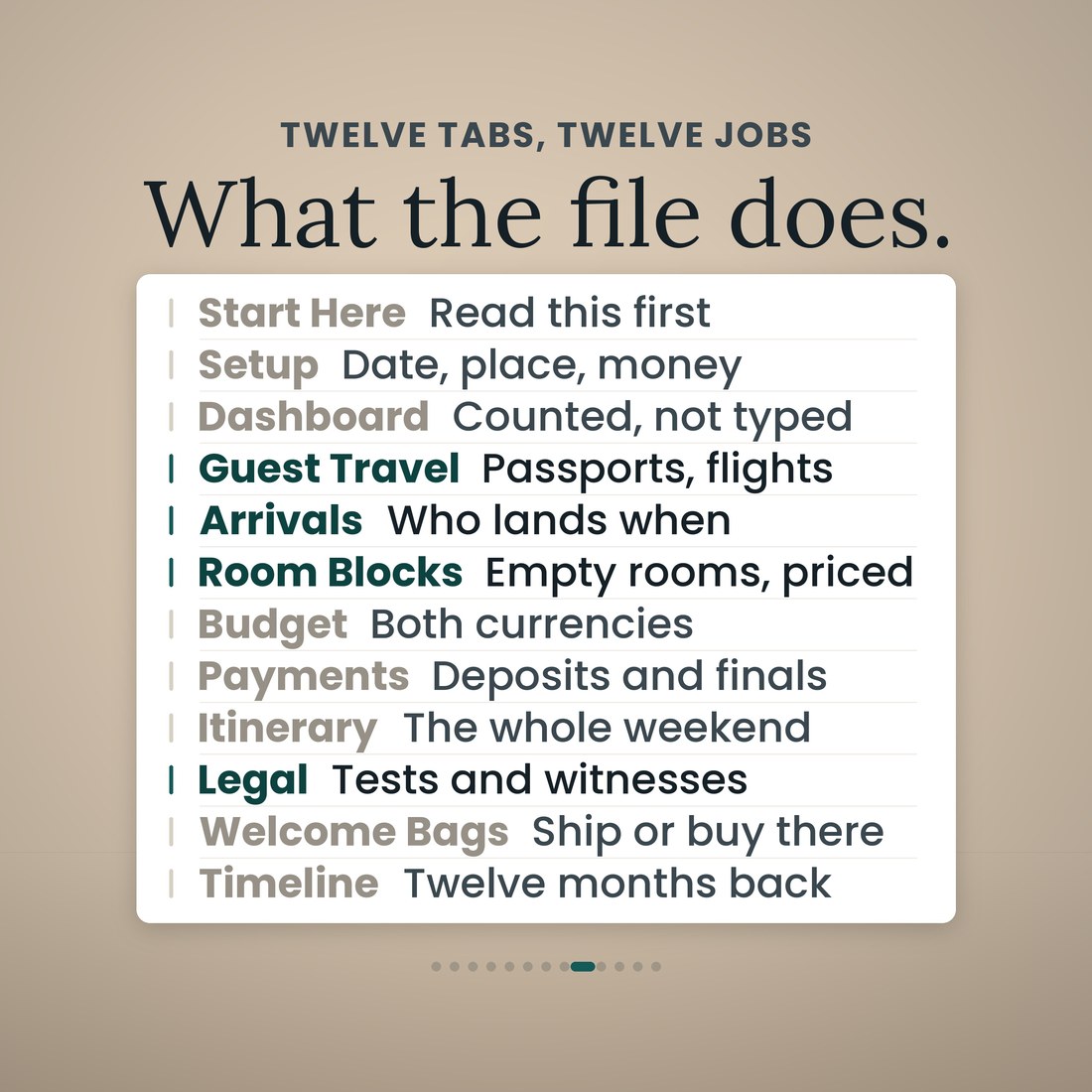
Start Here; Setup; Dashboard; Guest Travel; Arrivals; Room Blocks; Budget; Payments; Itinerary; Legal; Welcome Bags; and Timeline. Each one does a single job.
We already have a wedding website that takes RSVPs. Is this redundant?
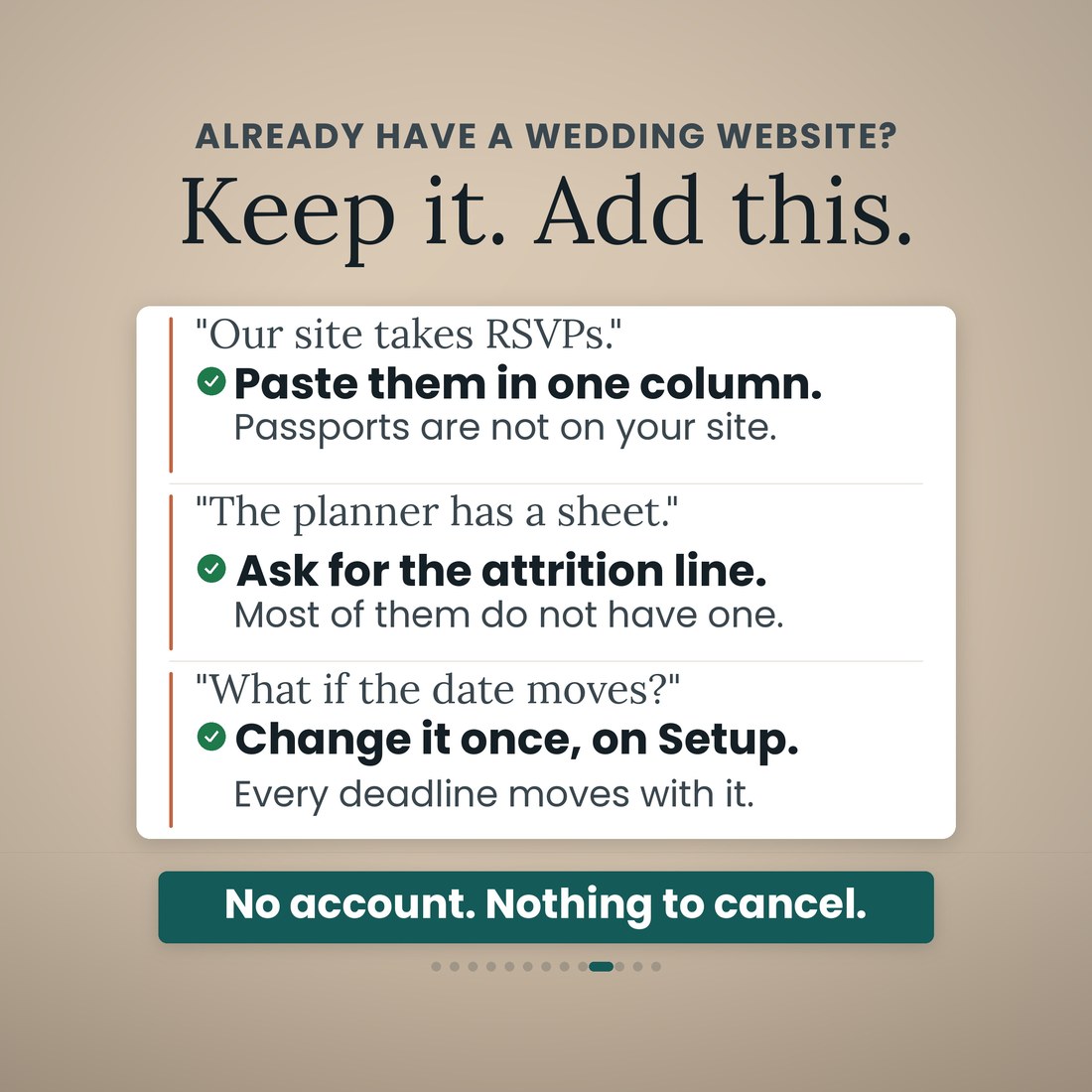
Keep it. Paste the replies into one column here. A wedding website collects who is coming; it does not hold passport expiry dates, it does not know your attrition clause, and it cannot tell you what nine empty rooms cost.
Our planner has a spreadsheet already.
Ask them for the attrition line in it. Most planner sheets do not have one, and the ones that do usually carry it as a typed number that nobody updates. You can run this alongside any planner's file; it is your copy of the arithmetic.
What if the wedding date changes?
Change it once, on Setup. The itinerary, the 22-task timeline and the ten legal start-by dates are all counted from that cell, so every deadline moves with it.
What is the difference between the four color editions?
Only the look. Colorful, Light, Dark and Editorial are the same 12-tab workbook with the same formulas in a different palette, and all four ship in the download.
Is this legal advice?
No. It is a planning tool that organizes the dates, documents and money you enter. Marriage requirements abroad change, they differ by country and often by state or municipality, and passport and entry rules are set by governments and not by this file. Confirm every line with the civil registry that will marry you, with your embassy or consulate, and with the resort holding your contract.
For personal use. A planning tool that organizes the guests, dates, documents and money you enter; not legal, immigration, tax or travel advice. Marriage and entry requirements change and differ by country and by state or municipality, and the passport rule, exchange rate and attrition percentage are cells you set and maintain. Confirm every requirement with the civil registry that will marry you, with your embassy or consulate, and with the hotel holding your contract. © 2026 NicheToolkitHub — no resale or redistribution.