 ▶
▶
 ▶
▶Injury Recovery & Return-to-Training Command Center
Rest is not the plan. Load is.
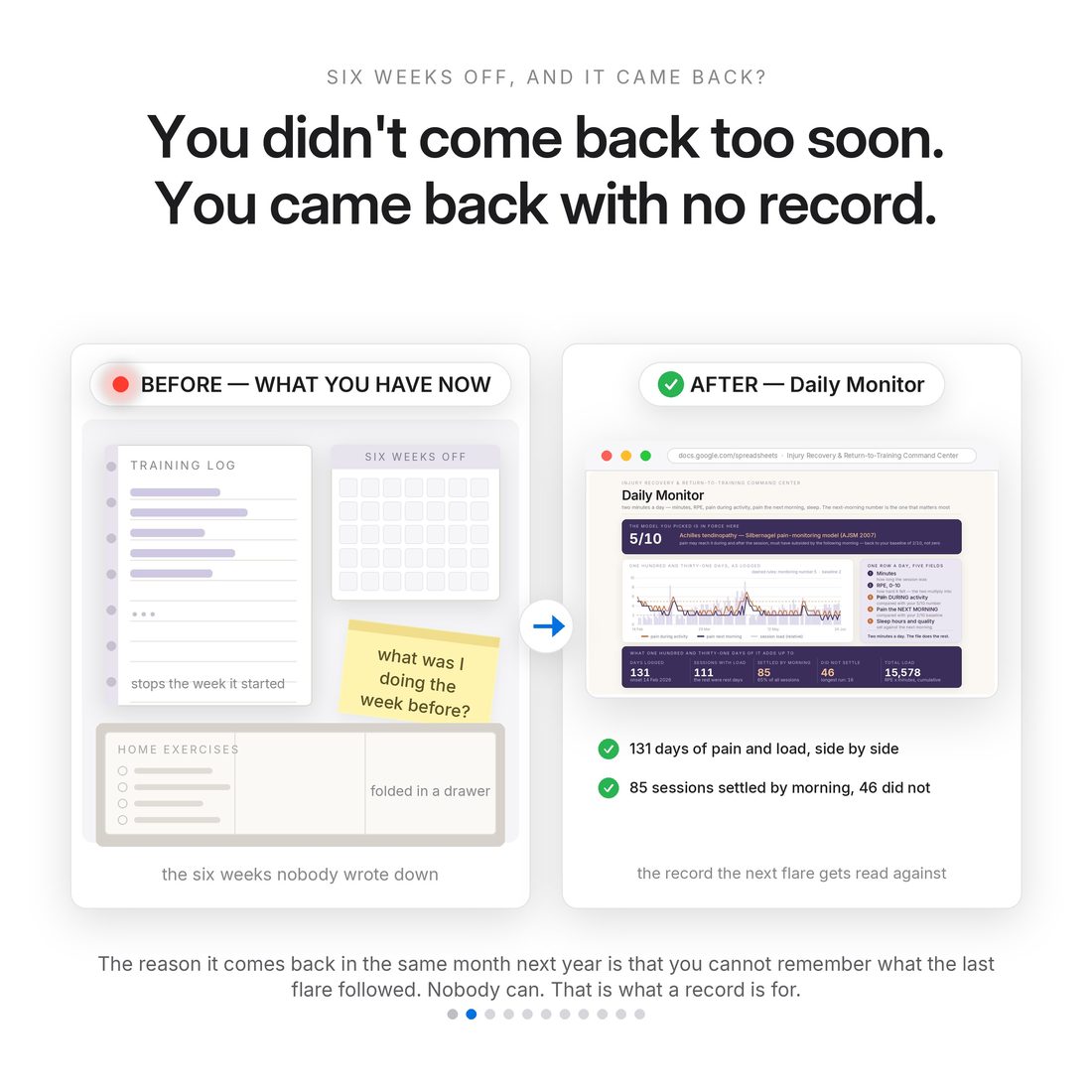
Rest is not the plan. Load is. The instinct is to stop until it stops hurting, then go back to what you were doing. That is why the same thing comes back in the same month the following year. You did not come back too soon. You came back with no record — and with no record, the week before the flare is gone. Nobody remembers it. So this file keeps it: two numbers a night, ten seconds, and eighteen weeks later you can see the shape of your own recovery instead of guessing at it.
- Daily Monitor — session, pain during, pain next morning, sleep, load — the whole engine
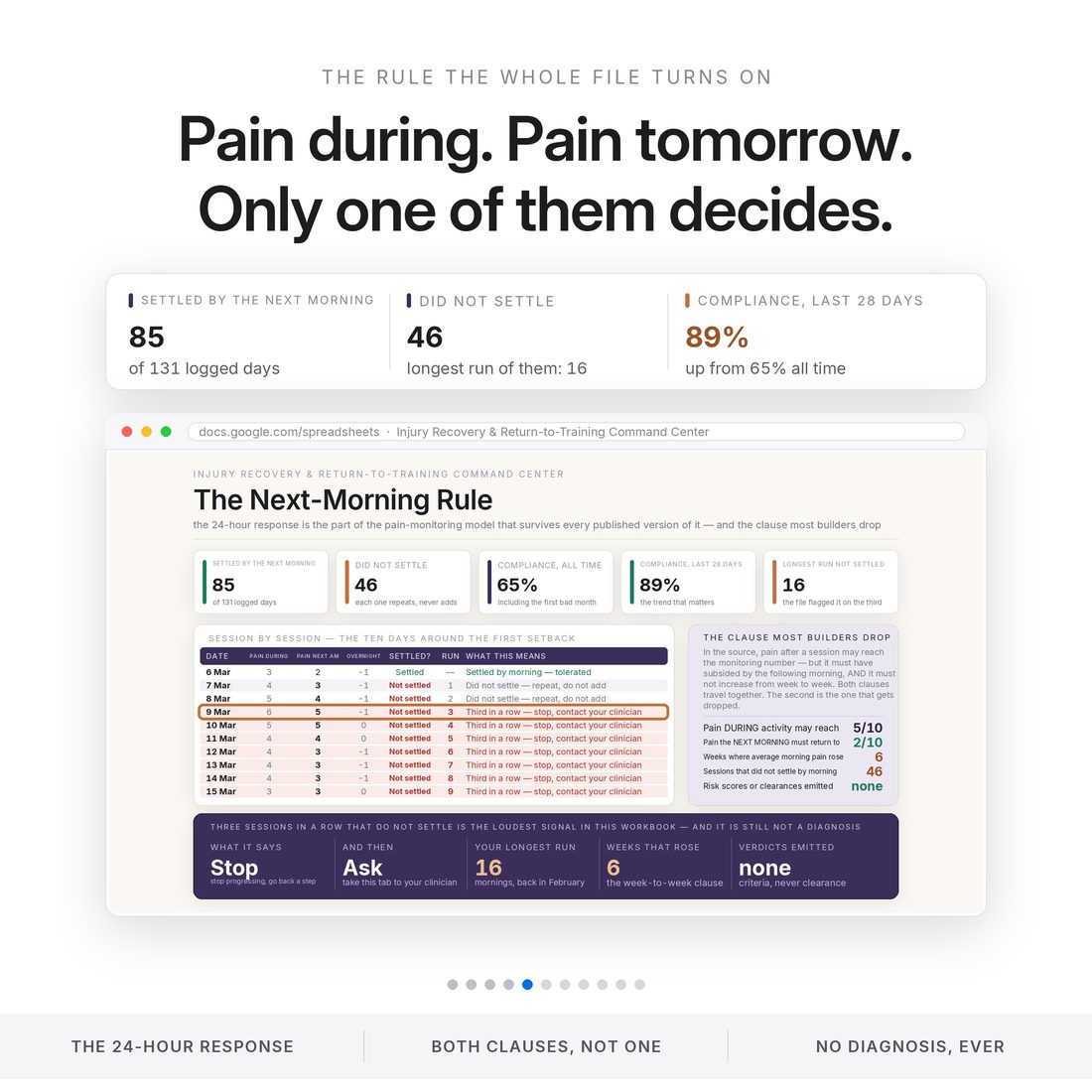
- The Next-Morning Rule — did it settle by morning; is the weekly trend flat or rising
- Setback Forensics — the week before each flare, kept in the file instead of in memory
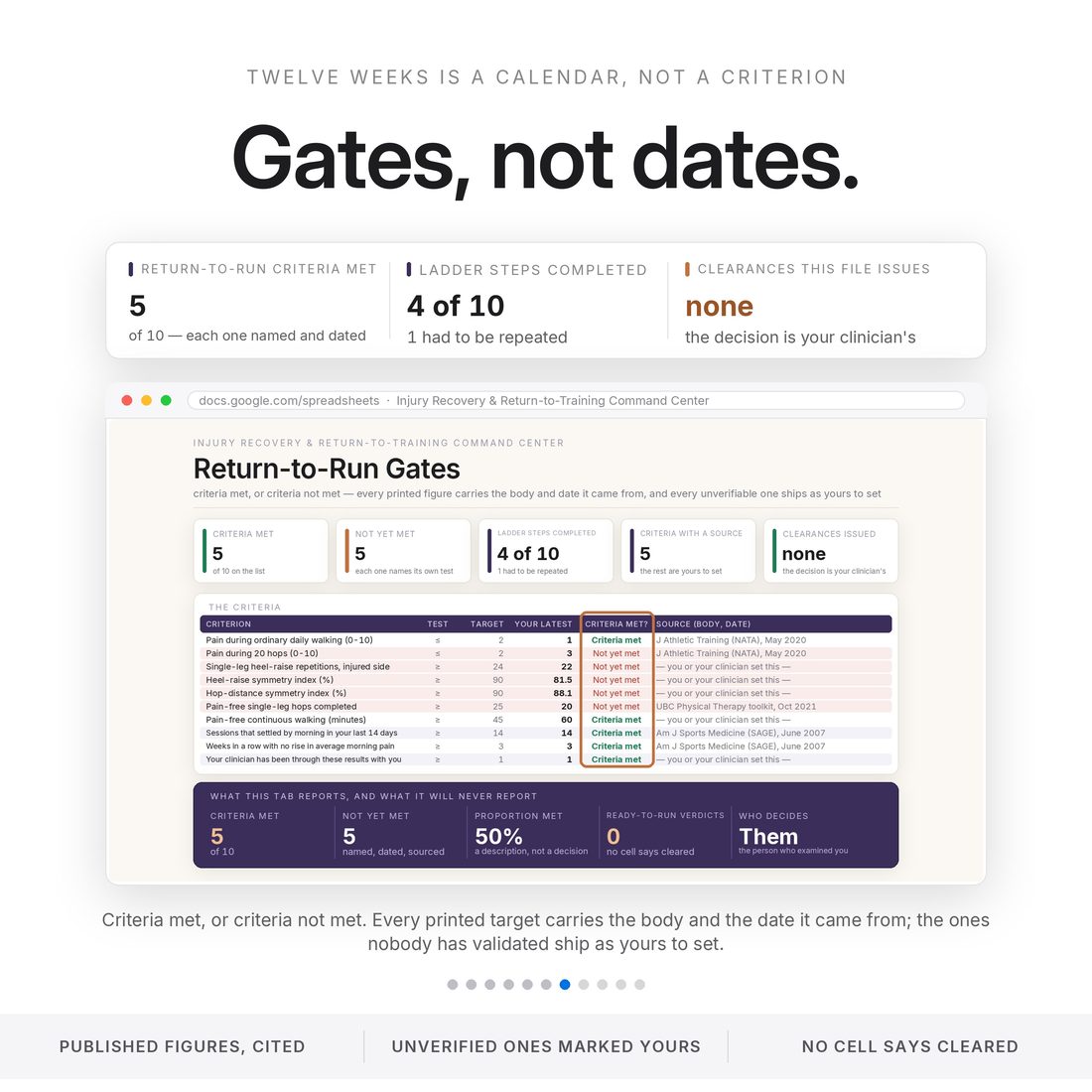
- Return-to-Run Criteria — ten gates, each with its source and date beside it
- Published pain models labelled and cited — you pick which one you work to
Overview
Rest is not the plan. Load is.
The instinct is to stop until it stops hurting, then go back to what you were doing. That is why the same thing comes back in the same month the following year. You did not come back too soon. You came back with no record — and with no record, the week before the flare is gone. Nobody remembers it. So this file keeps it: two numbers a night, ten seconds, and eighteen weeks later you can see the shape of your own recovery instead of guessing at it.
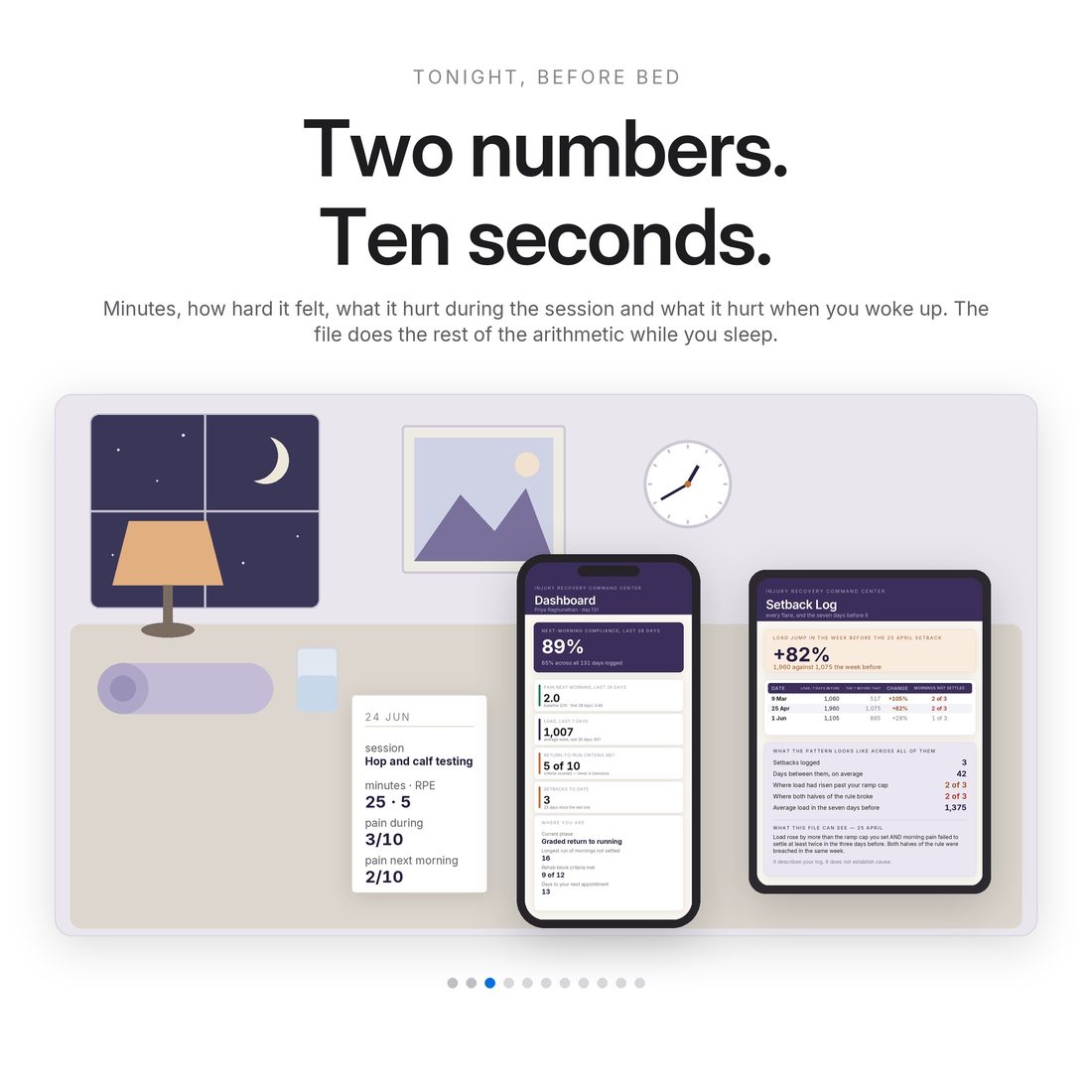
Two numbers a night. Ten seconds.
What's Included
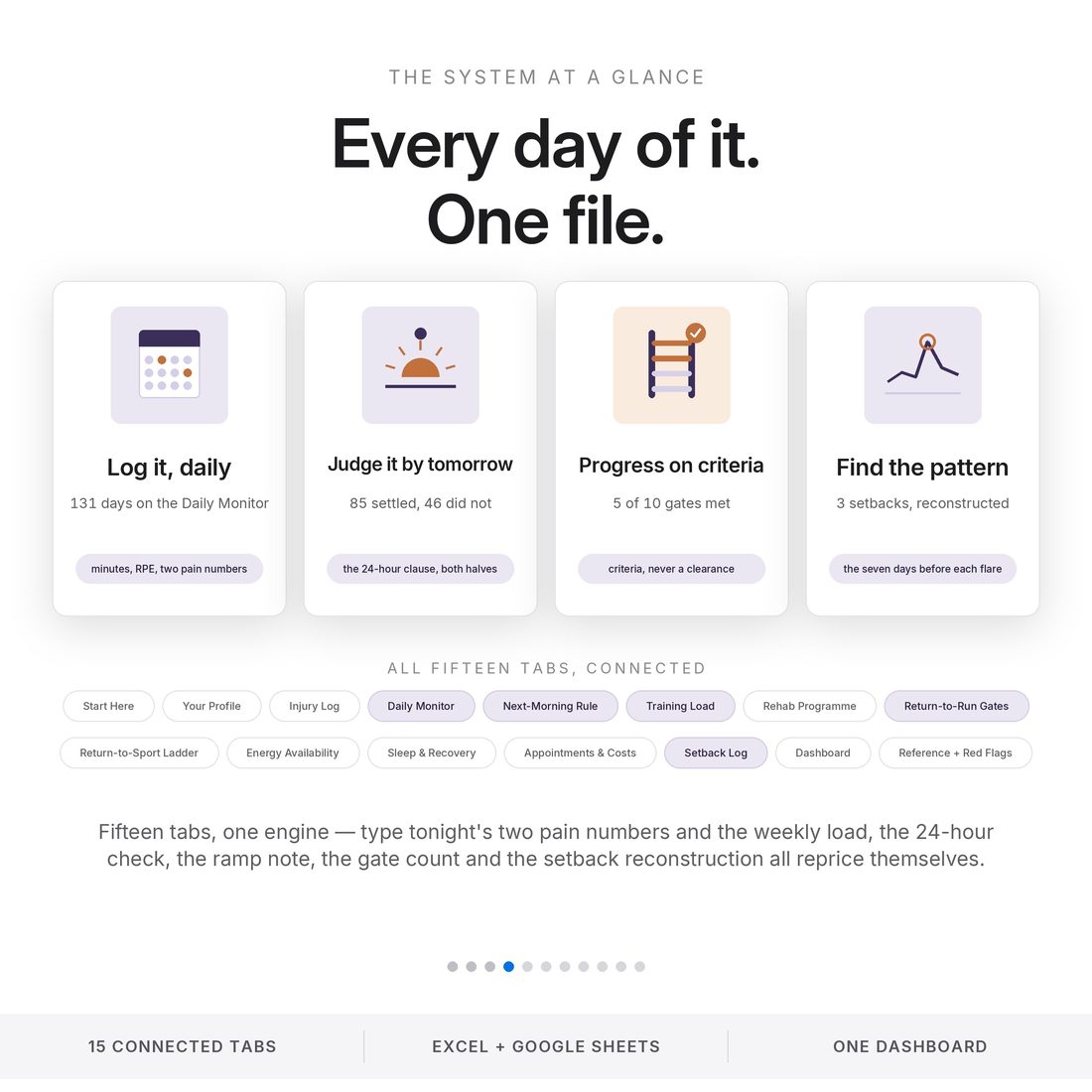
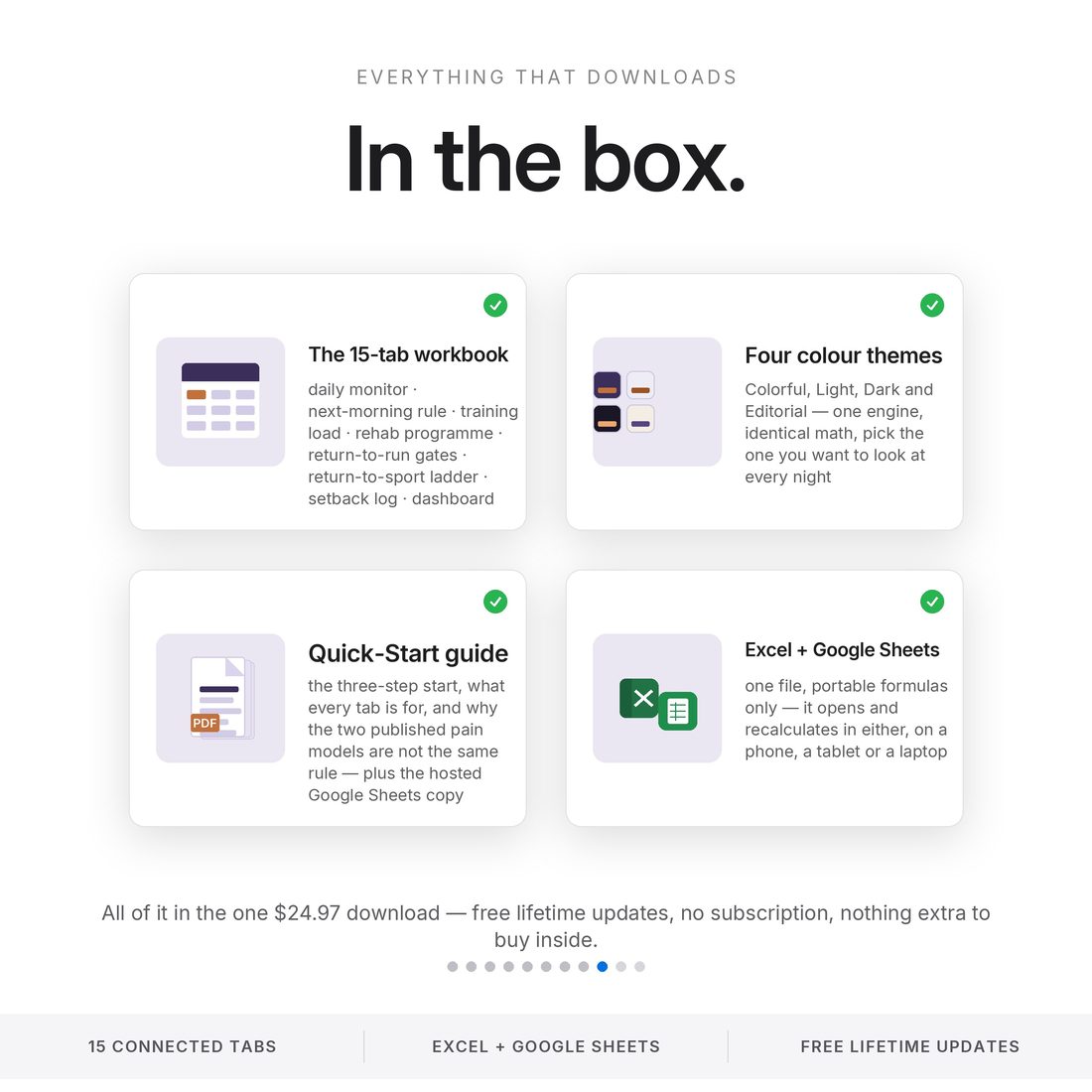
15 connected tabs:
- Injury-Recovery-Command-Center.xlsx — the 15-tab engine (Excel + Google Sheets)
- Bonus Themes folder — the same workbook in Light, Dark and Editorial
- Quick-Start-Guide.pdf + ACCESS-YOUR-TEMPLATE.pdf — one-click Google Sheets access + the video tutorial link
- README + LICENSE — delivered as one ZIP, instant download
Key Benefits
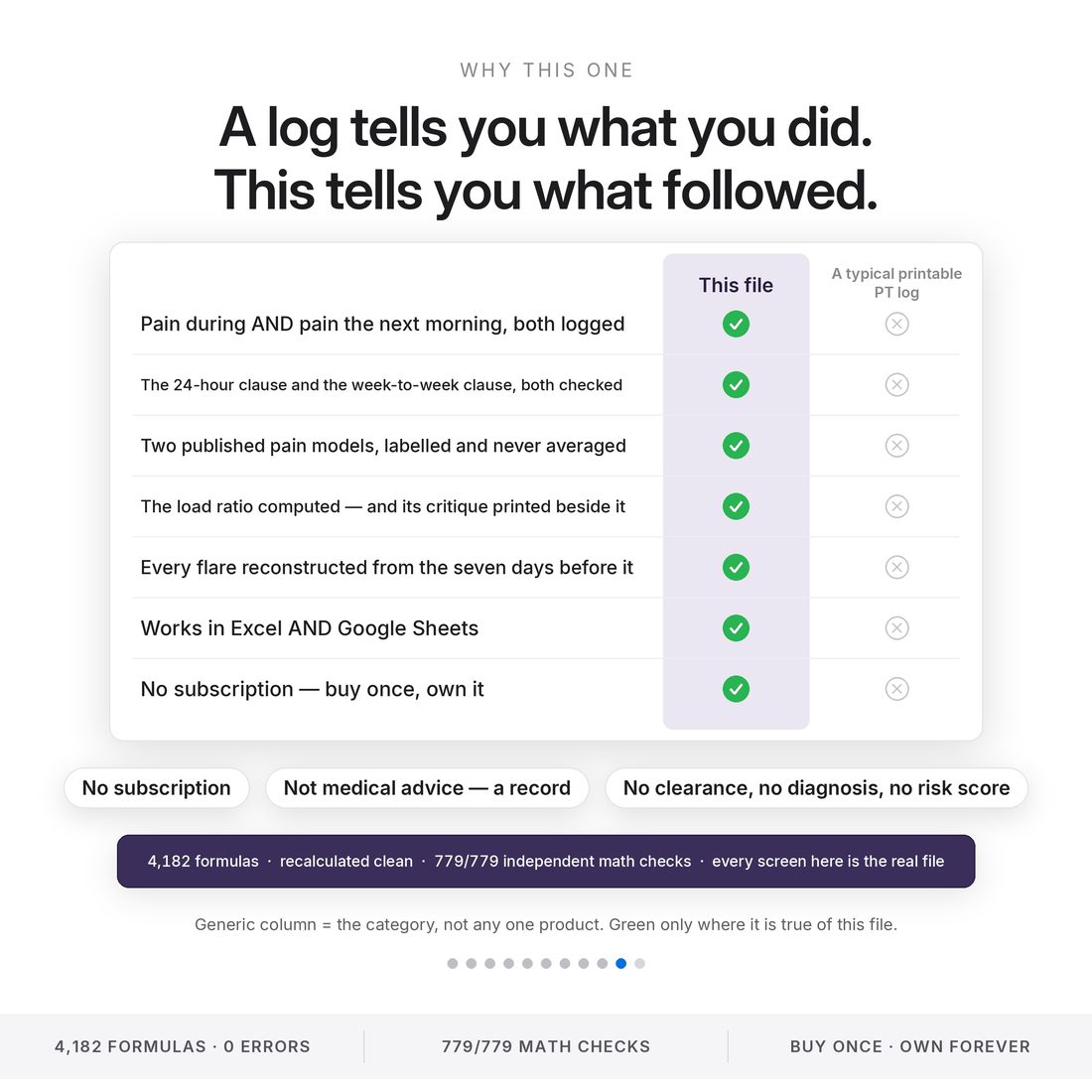
Why this one
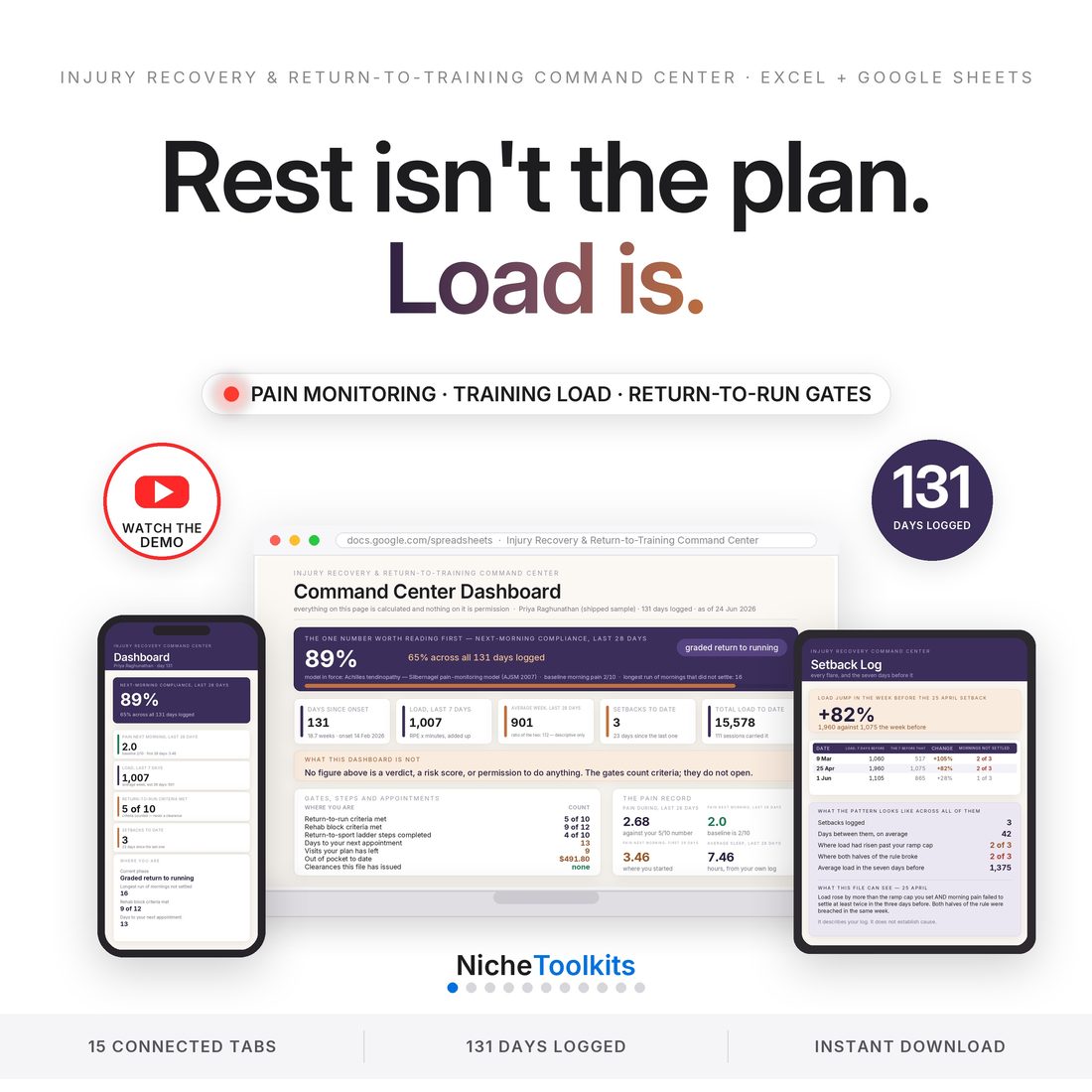
131 days, 111 sessions, 18.7 weeks in the sample — one row per day, ten seconds a night.
Pain settled by morning after 85 sessions and didn't after 46 — 65% overall, 89% across the last 28 days. Recovery you can see.
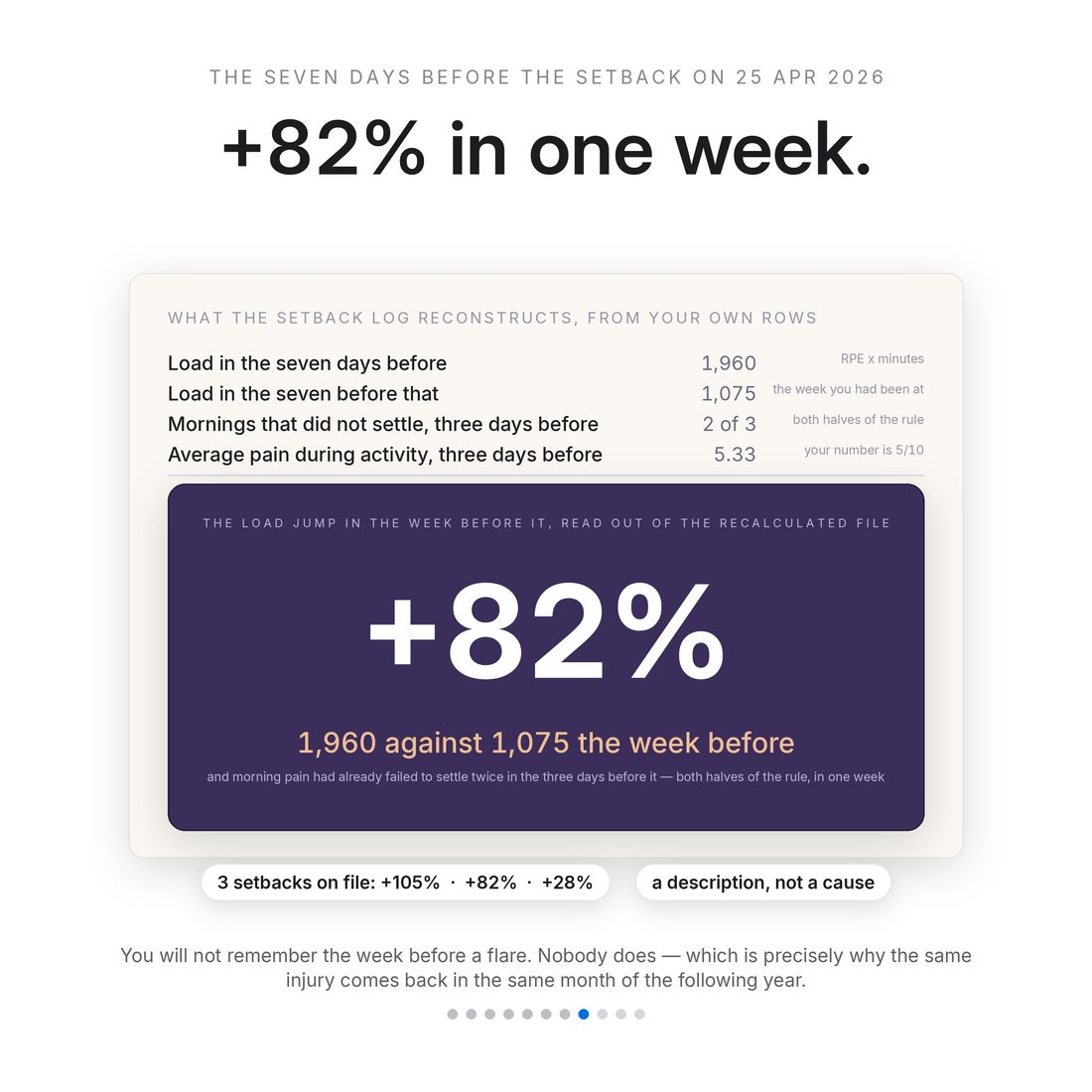
Before the worst setback: weekly load jumped 82% while morning pain had already failed twice. Both halves of the rule broken — in the file, not in hindsight.
5 of 10 return-to-run criteria met in the sample, each with its source and date beside it. The file never clears you — it shows the gates.
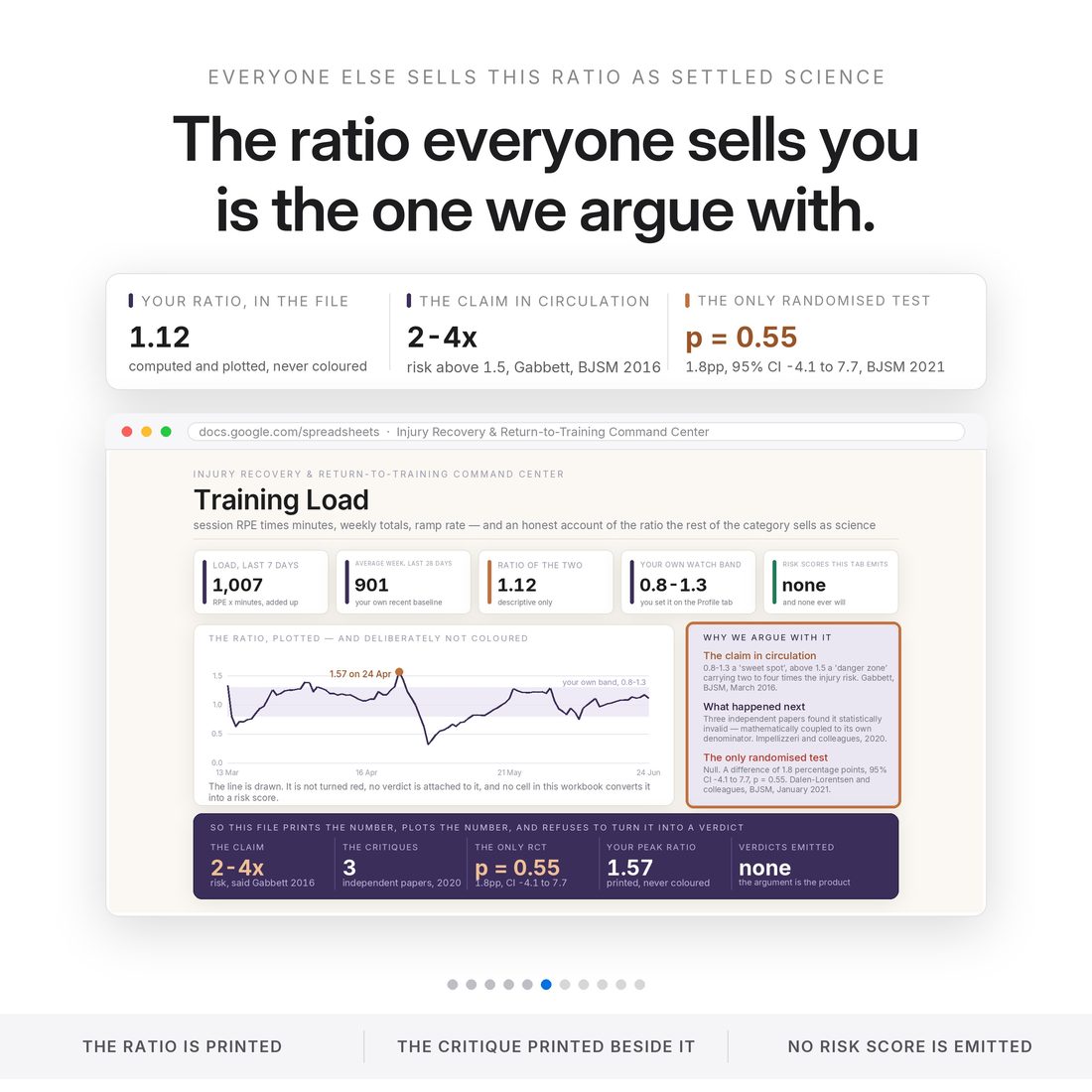
The load ratio prints as descriptive only — the file tells you it is not a validated risk score, because it isn't.
4,182 formulas · recalculated clean · 779/779 independent math checks. Every image is the real file.
Who It's For
Built for
- Runners and lifters mid-rehab who keep re-flaring the same thing
- Athletes working a clinician's program who want the record between visits
- Anyone told “let pain guide you” with no way to log what pain said
- Coaches and PTs who want a client's honest week, not their memory of it
How It Works
Up and running in minutes
The ACCESS-YOUR-TEMPLATE.pdf in your download opens a copy in Google Sheets with one click
Site, onset, mechanism — and what you were actually told
Pain during, pain next morning — ten seconds, one row per day
Weekly totals and the trend line; setbacks logged with their run-up preserved
Ten return-to-run criteria with sources — a checklist for the conversation, never a clearance
Why It's Different
Not another template
Rehab templates are exercise checklists. This is the record: the next-morning rule from the published models (labelled, cited, and not conflated), load with its honest limits, setback forensics, and criteria with sources — built so the week before the flare is never lost again.
Delivery & Compatibility
Instant, and works with what you use
As soon as your order is complete you get instant access to download your files. Prefer Google Sheets for real-time updates and dropdowns? It's fully optimized. More comfortable in Excel? It works just as well.
Built and tested in the latest Excel (Office 365). On Mac we recommend the Google Sheets version — the template is not compatible with Apple Numbers. Available in English. The template ships with sample data so every screen works on open; clear it whenever you're ready. The images and video show that sample data to demonstrate how it looks in use.
FAQ
Questions, answered
Does it work in Google Sheets?
Yes — one click: the ACCESS-YOUR-TEMPLATE.pdf in your download opens a copy straight into Google Sheets. The .xlsx works in Excel too.
Will it tell me when I can run again?
No — it shows the ten gates with sources and your status against them. Clearance is a clinical decision made by someone who has examined you.
Which pain rule does it use?
You pick: the published models ship labelled and cited (they differ by tissue and purpose), and the file never blurs them into one fake rule.
Is the load ratio a risk score?
No — it prints as descriptive only. The famous danger-zone claim has a published refutation, and this file says so.
Is anything pre-loaded?
A complete sample record (Priya Raghunathan — written sample data) ships inside so every screen works on open — it types over in one pass.
Can I get a refund on a digital download?
Because delivery is instant, all sales are final — but message us with any issue and we'll make it right.
This is a record-keeping tool — not medical advice, not physical therapy, not a diagnosis, not a medical device. It never clears you to return to sport. The first tab carries the red-flag list; any of those means stop and see a clinician. For personal use only. © 2026 NicheToolkitHub — no resale or redistribution.