 ▶
▶
 ▶
▶Rent Roll & Schedule E Landlord Pack
Every unit paid, every dollar on its line.
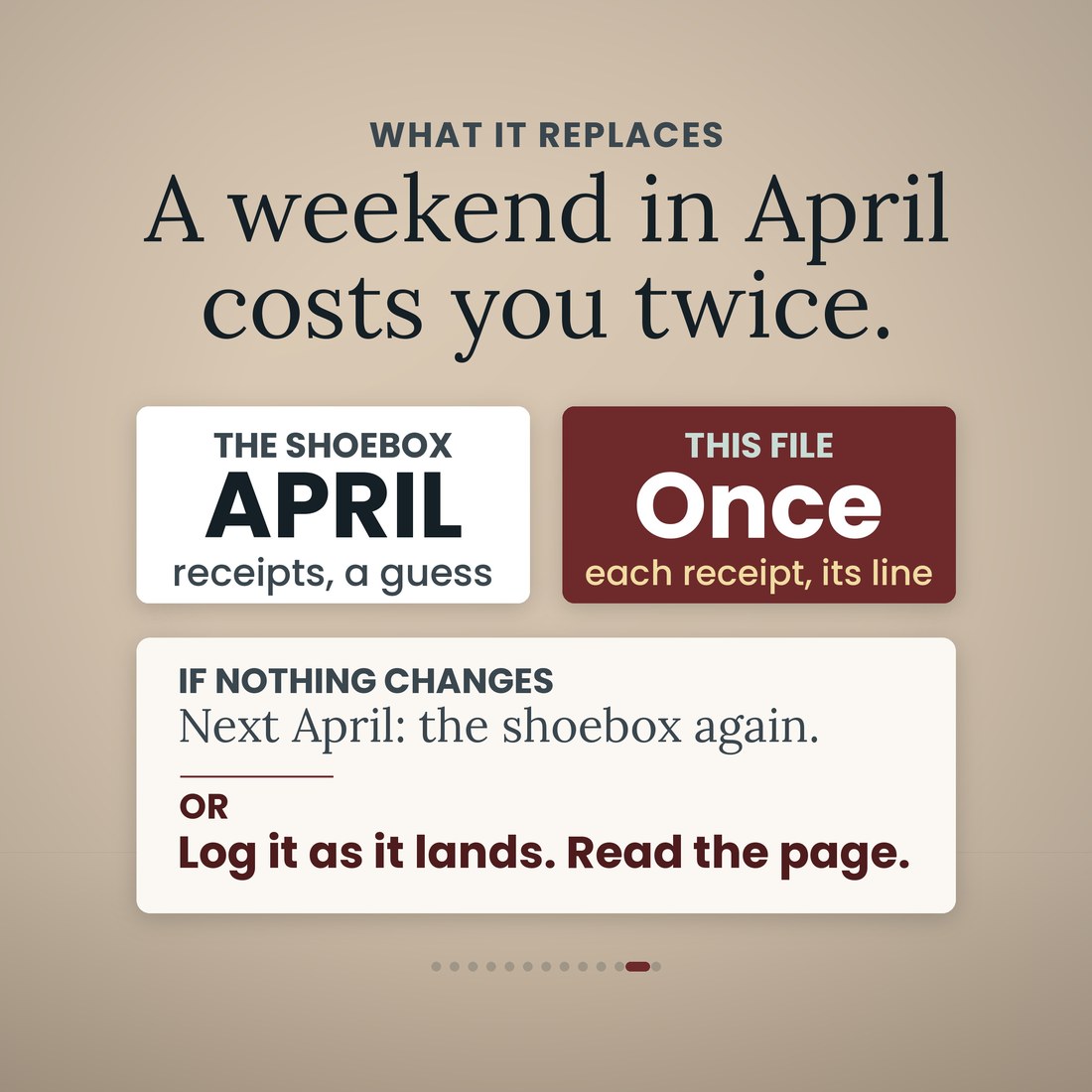
The first of the month comes around and you are scrolling text messages to remember who paid. April comes around and the receipts are in a shoebox, the new roof is in there somewhere, and nobody can say what line it goes on. This file keeps the rent roll, keeps the ledger, and files every receipt on the Schedule E line it belongs to as you go, so the next rent day and the next tax season are both already handled.
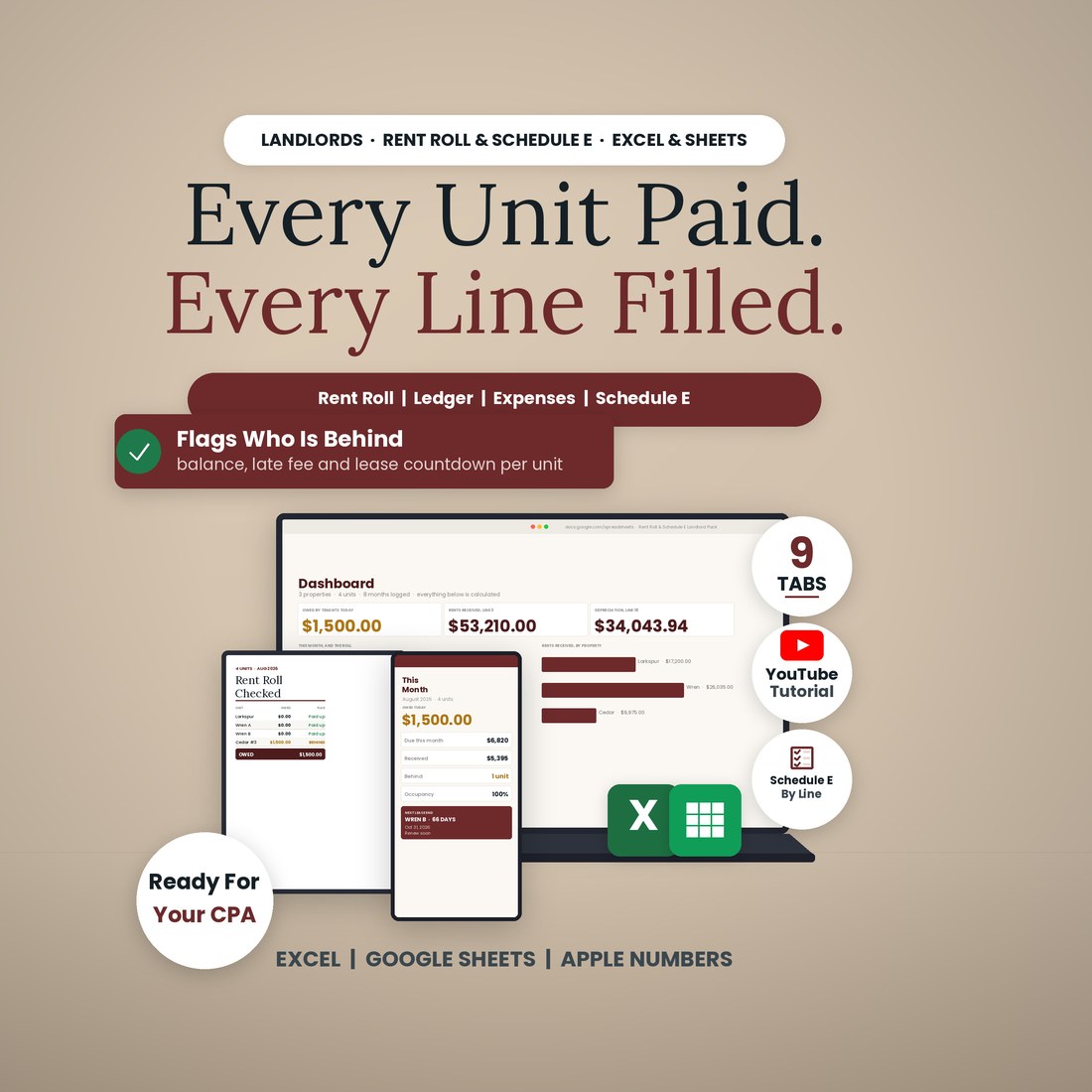
- Rent Roll, one line per unit and nothing typed: charged, paid, balance owed, this month paid or not, a BEHIND flag with the dollars, and the lease countdown in days with Renew soon at 90 days and red at 30
- Rent Ledger: one row per charge and one row per payment, late fees as their own rows, the running balance per unit in date order
- Expenses: one row per receipt on the Schedule E line it belongs to, from a drop-down, plus a mileage log at the IRS standard rate (72.5 cents through June 2026 and 76 cents from July, both editable)
- Schedule E (Form 1040), Part I, lines 3 to 26, one column per property and the total column, with the 23a to 26 totals block, built from the ledger, the expenses and the depreciation
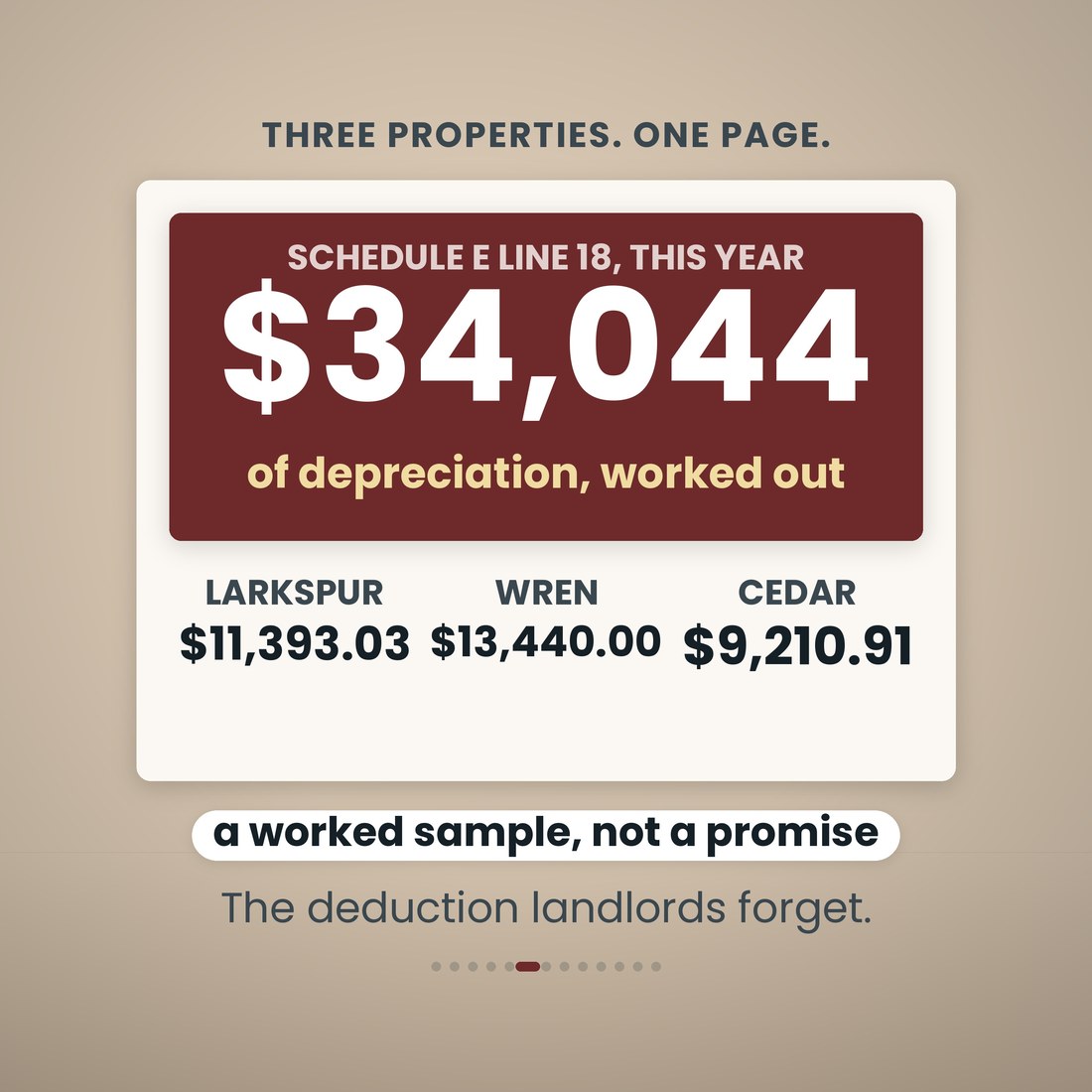
- Depreciation: 27.5-year straight line, mid-month convention, for the buildings from Setup and the improvements you add, with this year's line 18 worked out for each
Overview
Every unit paid, every dollar on its line.
The first of the month comes around and you are scrolling text messages to remember who paid. April comes around and the receipts are in a shoebox, the new roof is in there somewhere, and nobody can say what line it goes on. This file keeps the rent roll, keeps the ledger, and files every receipt on the Schedule E line it belongs to as you go, so the next rent day and the next tax season are both already handled.
It is one workbook with 9 tabs and 4,226 formulas, and it opens the same way in Microsoft Excel, Google Sheets and Apple Numbers because every formula uses the portable function set — no add-ins, no macros, no login and nothing to install. You type in the cream cells only: your properties and units once, a charge row and a payment row as rent lands, and each receipt on its line from a drop-down. The Rent Roll, the Schedule E page, the depreciation and the Dashboard are all read, never typed. One rental is one row; the file holds six properties and twelve units if you grow, with 400 ledger rows, 300 expense rows and 40 mileage rows, and the Schedule E tab prints one column per property, three per page, the way the form reads. A worked sample ships inside — three small rentals near Denver, four tenants, January to August 2026 — so every tab has something to show. Clear the sample rows and the formulas stay.
What's Included
One workbook, 9 tabs, in four color editions:
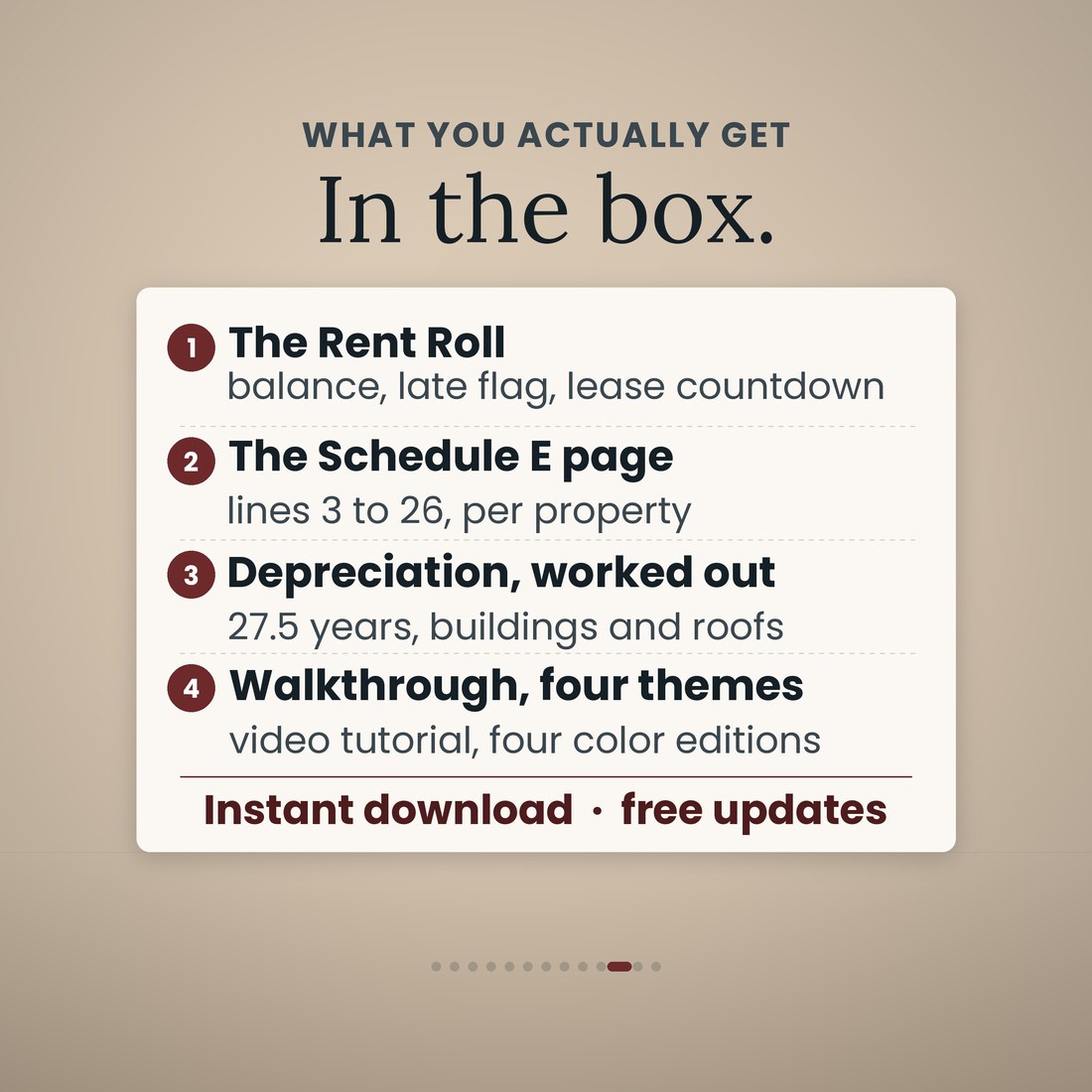
- Rent-Roll-Schedule-E-Landlord-Pack.xlsx: the 9-tab workbook with 4,226 formulas, opening in Microsoft Excel, Google Sheets and Apple Numbers
- The same workbook in four color editions — Colorful, Light, Dark and Editorial — every one doing the same arithmetic
- A worked sample book inside: three small rentals, four tenants, eight months, so every tab works on open
- The Schedule E page laid out the way the form reads, one column per property, ready to hand to your preparer
- A full narrated video walkthrough on YouTube, linked on your confirmation page
- Five .xlsx files in one ZIP, instant download. Nothing is shipped and there is nothing to install
Key Benefits
Why this one
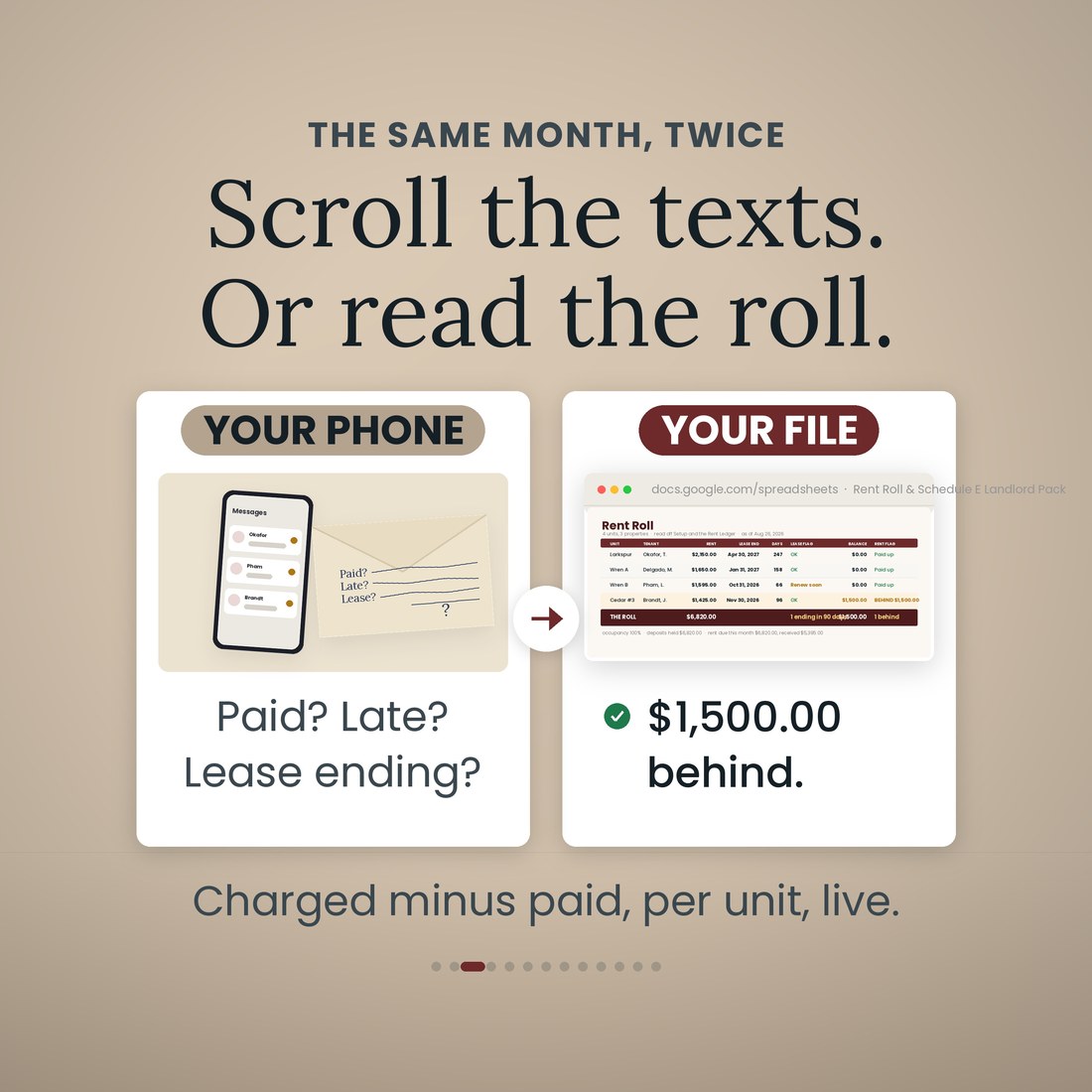
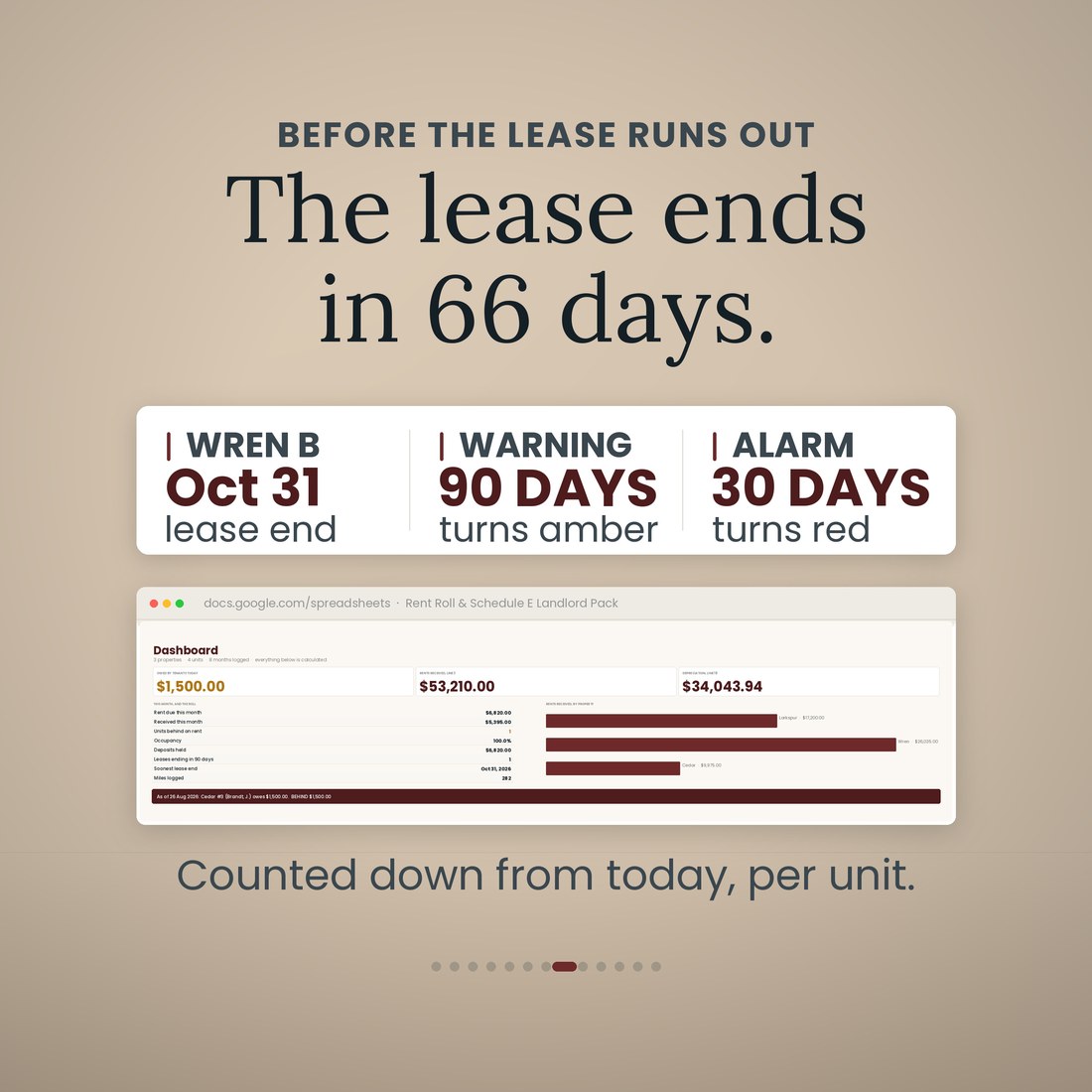
The Rent Roll works out charged, paid and balance owed per unit from the ledger and flags BEHIND with the amount. On the sample, Cedar #3 shows BEHIND $1,500.00: August rent plus the $75 late fee. Nothing on the roll is typed.
Each expense is filed on a Schedule E line from a drop-down the day you enter it, with a box for whether you kept the receipt. By April the Schedule E tab already reads lines 3 to 26 per property, and the shoebox is a column.
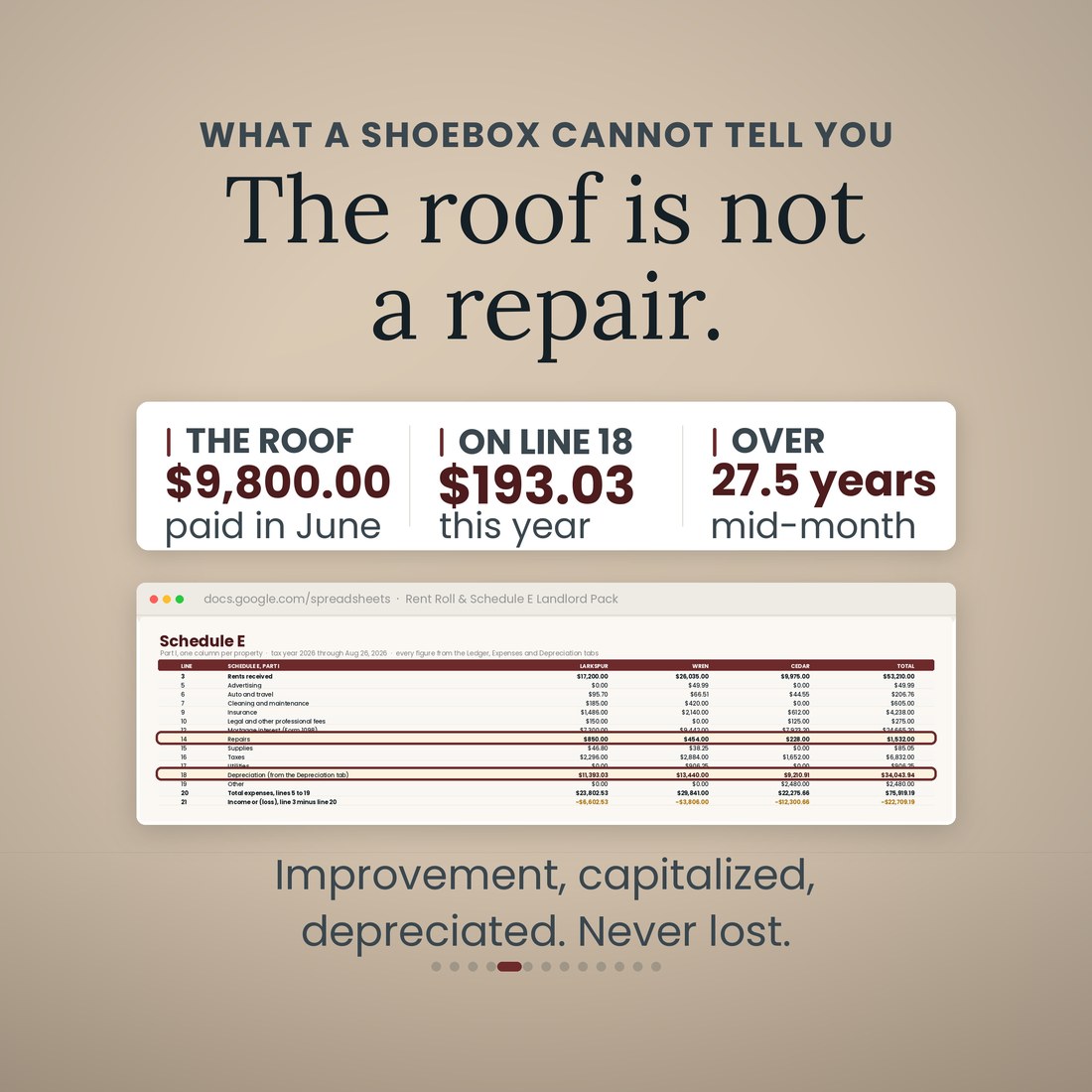
The Depreciation tab works out 27.5-year straight-line, mid-month depreciation for the buildings from Setup and the improvements you add. On the sample a $9,800 roof goes on line 18 at $193.03 this year rather than on line 14 as a repair.
Every unit carries a lease countdown in days. The roll turns amber 90 days out and red at 30, and the Dashboard counts down from today. On the sample, Wren B ends October 31, 66 days out, flagged Renew soon.
Schedule E (Form 1040), Part I, lines 3 to 26, one column per property and the totals block from 23a to 26, built from the ledger, the expenses and the depreciation. Your preparer signs the return; the file does the arithmetic and keeps the receipts on the right lines.
Microsoft Excel, Google Sheets and Apple Numbers. Every formula uses the portable function set, and the file was recalculated clean before shipping. No add-ins, no macros, no login, no rent portal.
Who It's For
Built for
- Small landlords with one to twelve units who do their own books and hand a preparer a clean Schedule E
- House hackers with a rented unit or a basement apartment, who need one row and one page
- Anyone who has tried to reconstruct a year of rent from a text-message thread
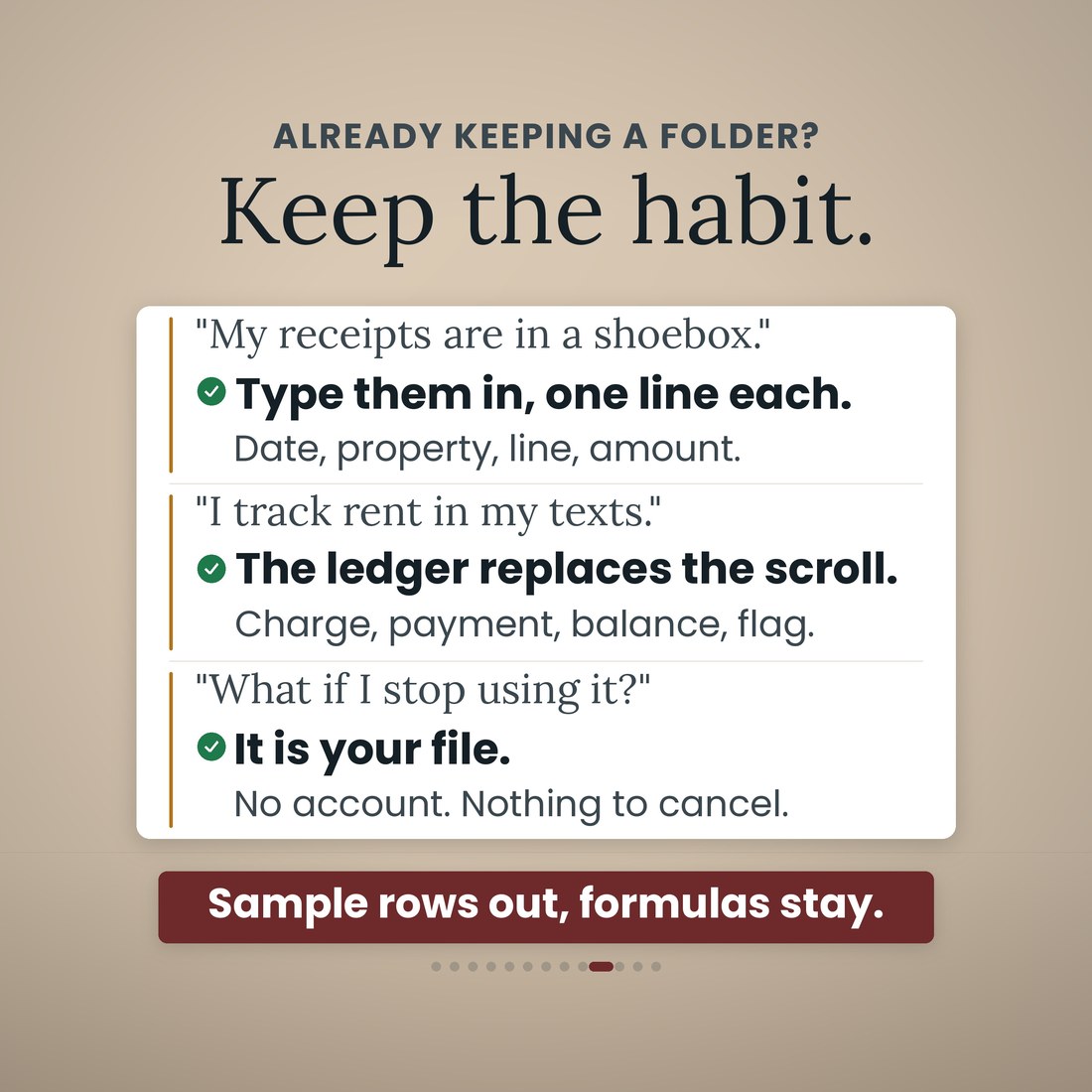
- Landlords who want the file on their own laptop, with no rent portal, no account and nothing to cancel
How It Works
Up and running in minutes
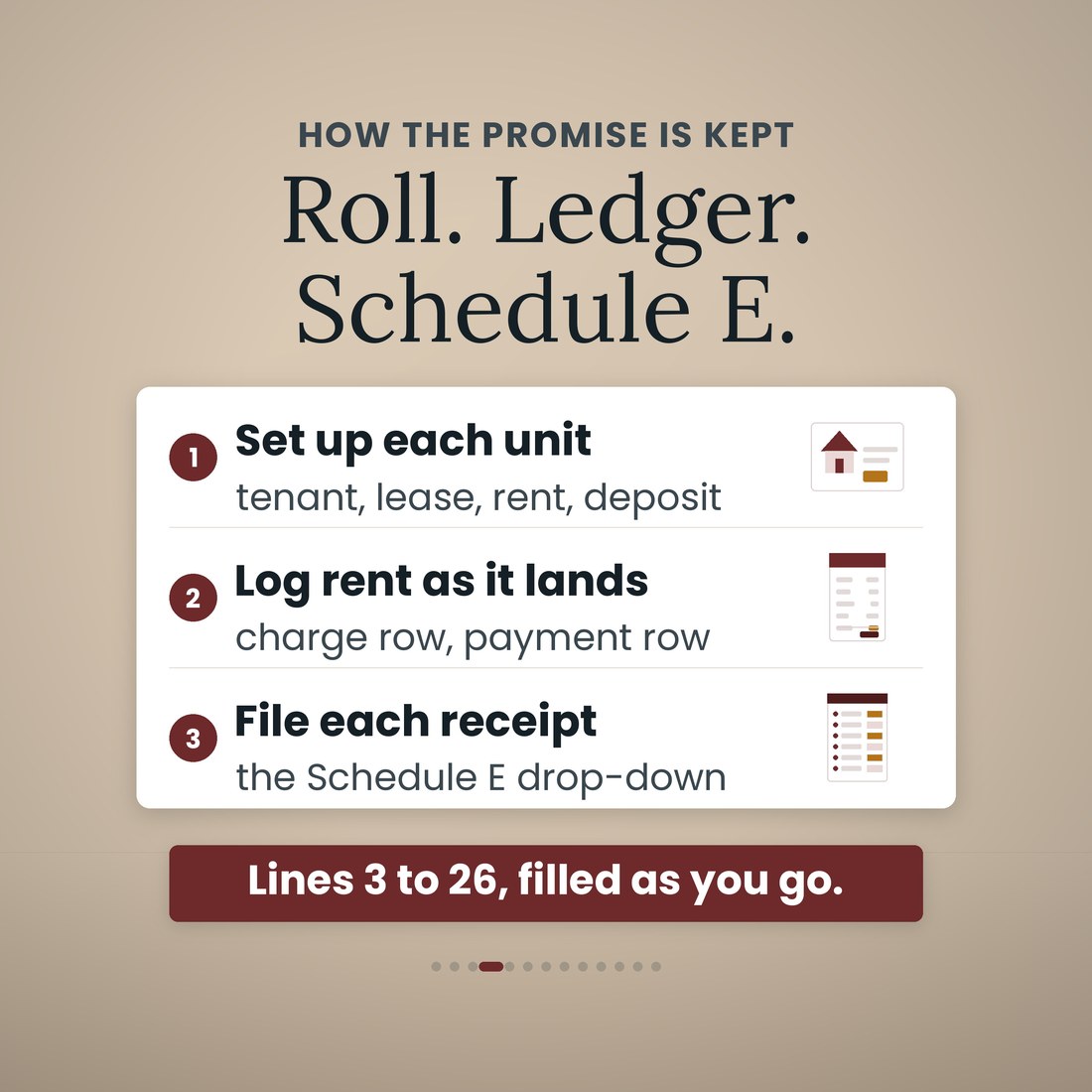
Purchase price split into land and building, placed-in-service date, tenants, lease dates, rent, deposit, late fee and grace period. Once.
A charge row on the first and a payment row when it arrives, on the Rent Ledger. Late fees get their own rows.
One row per receipt on the Expenses tab, with the Schedule E line picked from a drop-down and a box for whether you kept the receipt.
The Rent Roll shows who has paid this month, who is behind and by how much, and whose lease ends next, without typing a thing.
Lines 3 to 26 per property, depreciation on line 18 already worked out, one column per property the way the form reads. Hand it to your preparer.
Why It's Different
Not another template
Most landlord spreadsheets are a rent tracker with an expense tab, and Schedule E is left for April. This one is organized around the form from the first receipt: every expense is filed on its line the day it is entered, depreciation is worked out over 27.5 years with the mid-month convention rather than left as a note to the preparer, and the Schedule E tab prints one column per property the way the form reads. On the rent side the roll is read, never typed — charged, paid, balance, a BEHIND flag with the dollars and a lease countdown that turns amber at 90 days and red at 30 — because it is all worked out from the ledger. It is honest about its limits too: passive-loss limits, the repair-versus-improvement tests and your state's late-fee cap are your preparer's call, and the file says so.
Delivery & Compatibility
Instant, and it opens in what you already use
As soon as your order is complete you get instant access to download the ZIP, so you can set up your units tonight and read the roll on the first.
Five .xlsx workbooks (the pack plus Colorful, Light, Dark and Editorial editions) delivered as one ZIP, instant download. Opens in Microsoft Excel, Google Sheets and Apple Numbers using the portable function set only — no add-ins, no macros, no login and nothing to install. The file ships with a worked sample book so every screen works on open; the images and video show that sample. Mileage rates ship as the 2026 IRS standard rates in editable cells. This is a digital download; nothing is shipped.
FAQ
Questions, answered
I only have one rental. Is this too much?
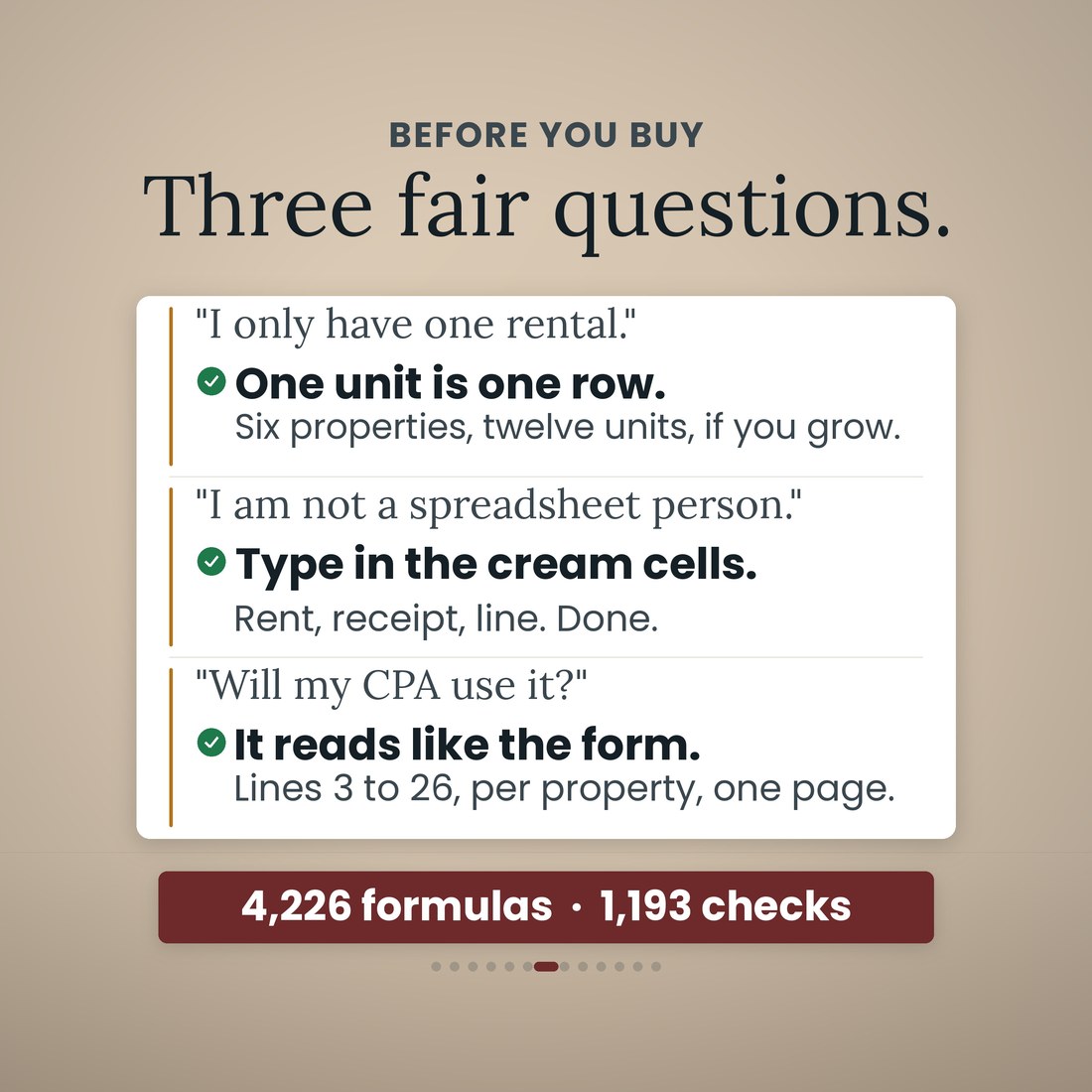
One unit is one row. The file holds six properties and twelve units if you grow, and the Schedule E page prints one column per property, three per page, the way the form reads. With one unit you fill one row on Setup and read one column.
I am not a spreadsheet person. How much do I have to type?
You type in the cream cells only: your properties and units once, a charge row and a payment row as rent lands, and each receipt on its line from a drop-down. Every other cell is a formula, 4,226 of them. The Rent Roll, the Schedule E page, the depreciation and the Dashboard are all read, never typed.
Will my CPA use it?
It reads like the form. Schedule E (Form 1040), Part I, lines 3 to 26, per property, plus the totals block from 23a to 26, built from the ledger, the expenses and the depreciation tab. Your preparer signs the return; the file does the arithmetic and keeps the receipts on the right lines.
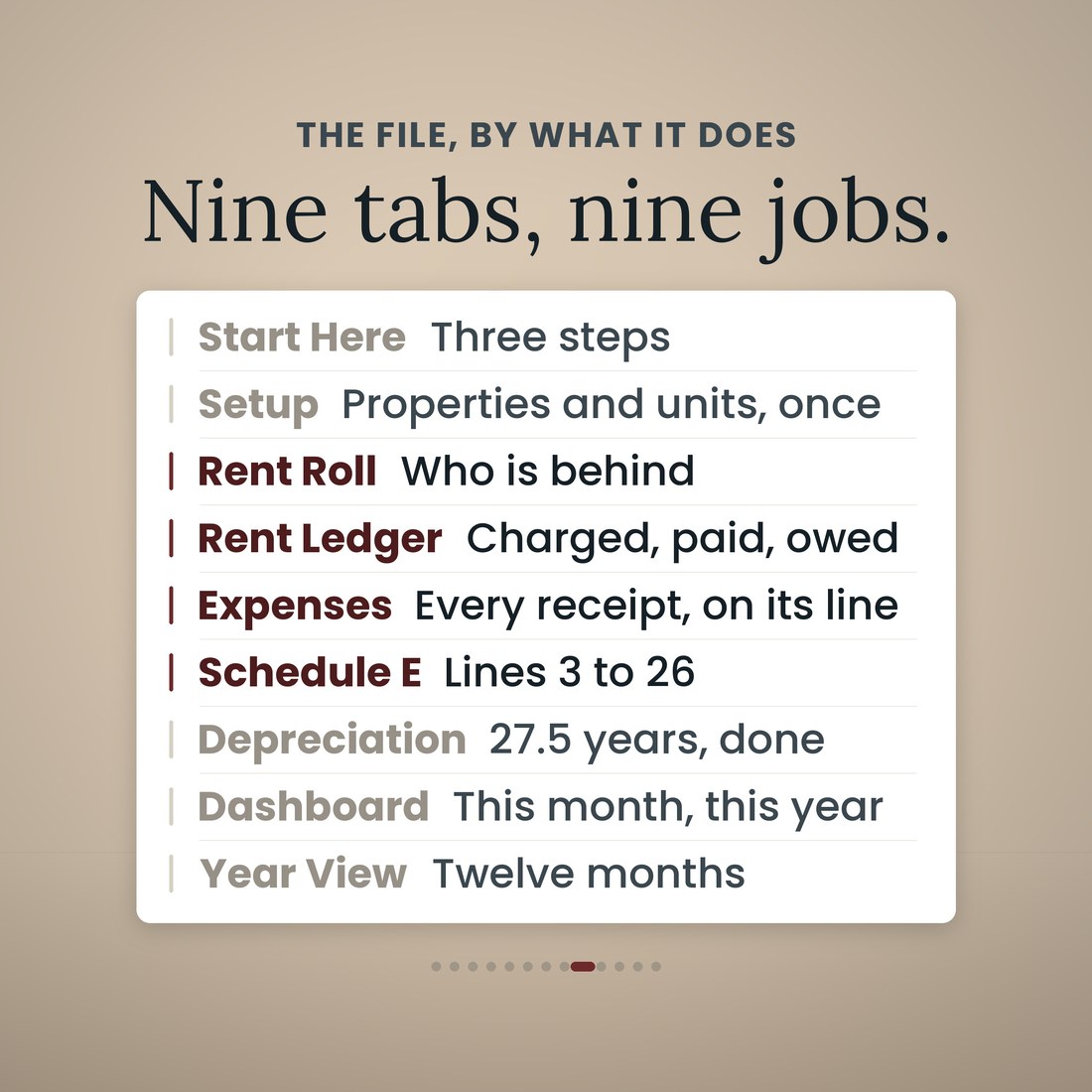
What are the nine tabs?
Start Here; Setup; Rent Roll; Rent Ledger; Expenses; Schedule E; Depreciation; Dashboard; and Year View. Each does one job.
How does depreciation work in it?
27.5-year straight line with the mid-month convention, for the buildings you enter on Setup (purchase price split into land and building, with the placed-in-service date) and for the improvements you add, such as a roof, a furnace or a remodel. This year's line 18 is worked out for each. On the sample, a $9,800 roof placed in service in June is depreciated at $193.03 this year instead of deducted as a repair.
How does the late-rent flag work?
The Rent Ledger holds a charge row and a payment row per unit, with late fees as their own rows, and the Rent Roll reads the balance. A unit that owes shows BEHIND with the dollars; on the sample that is Cedar #3 at $1,500.00, August rent plus the $75 late fee. The Dashboard puts it in a sentence.
Does it track the mileage deduction?
Yes. The Expenses tab carries a mileage log at the IRS standard rate, with the 2026 rates loaded, 72.5 cents through June and 76 cents from July, in editable cells, so trips to the property land on line 6 at the right rate.
What is the difference between the four color editions?
Only the look. Colorful, Light, Dark and Editorial are the same 9-tab workbook with the same formulas in a different palette, and all four ship in the download.
Is this tax advice?
No. It is a record-keeping tool that organizes your rent and expenses by Schedule E line from what you enter; it is not tax, legal or accounting advice. Passive-loss limits (line 22, Form 8582), the repair-versus-improvement tests and your state's late-fee cap are your preparer's call.
For personal use. A record-keeping tool that organizes your rent and expenses by Schedule E line from what you enter; not tax, legal or accounting advice. © 2026 NicheToolkitHub — no resale or redistribution.