 ▶
▶
 ▶
▶Debt & Buy Now Pay Later Command Center
Your credit report can't see them. That's why you can't either.
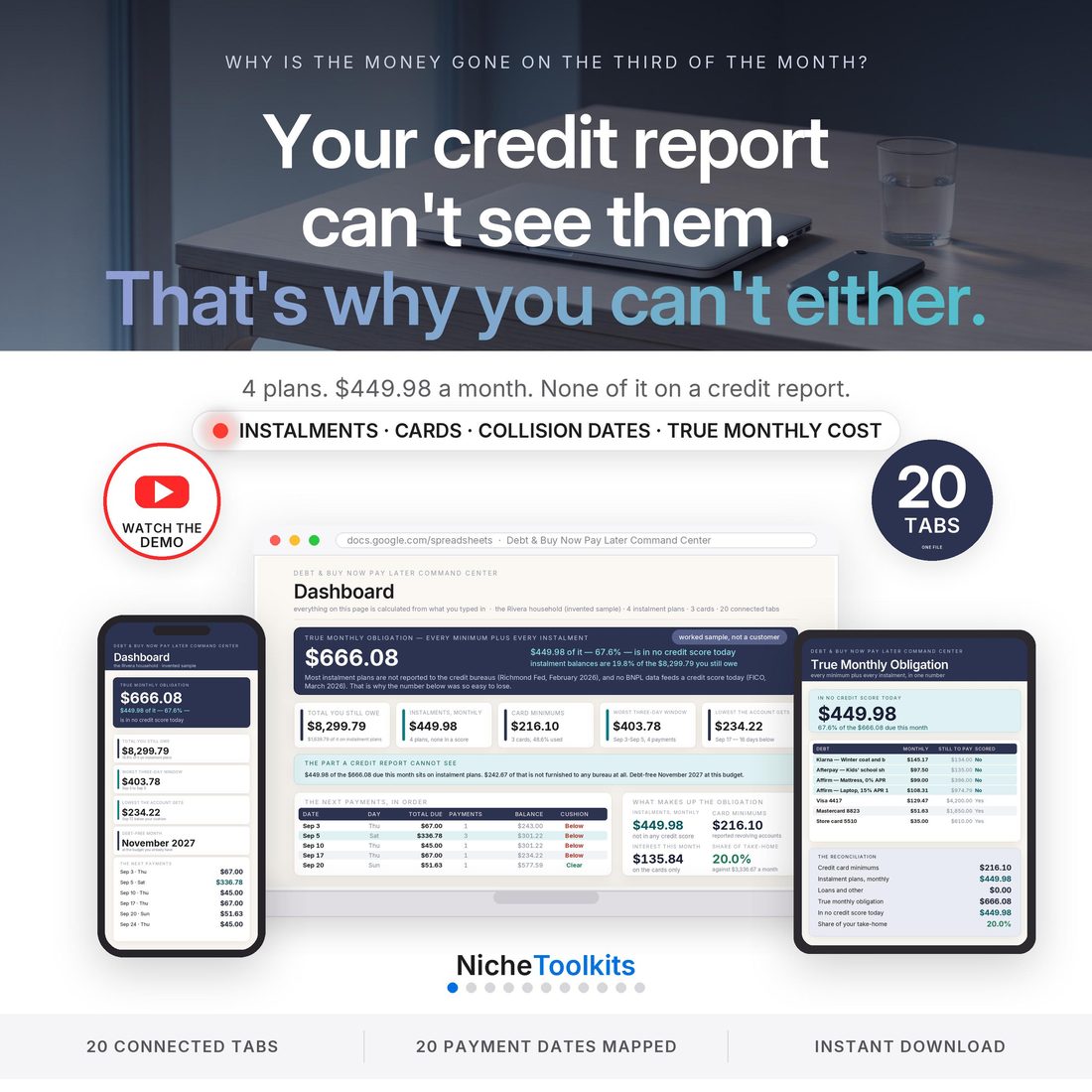
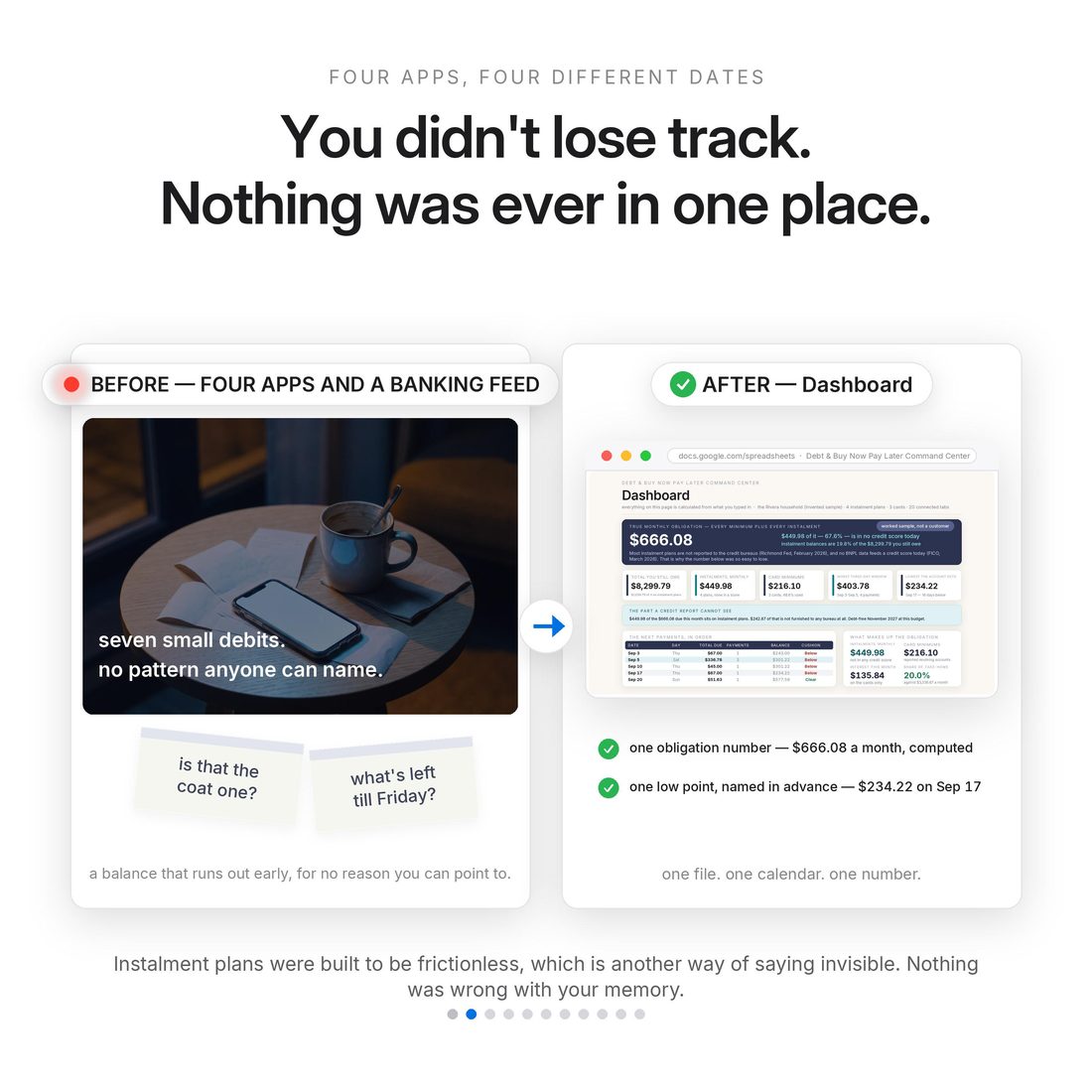
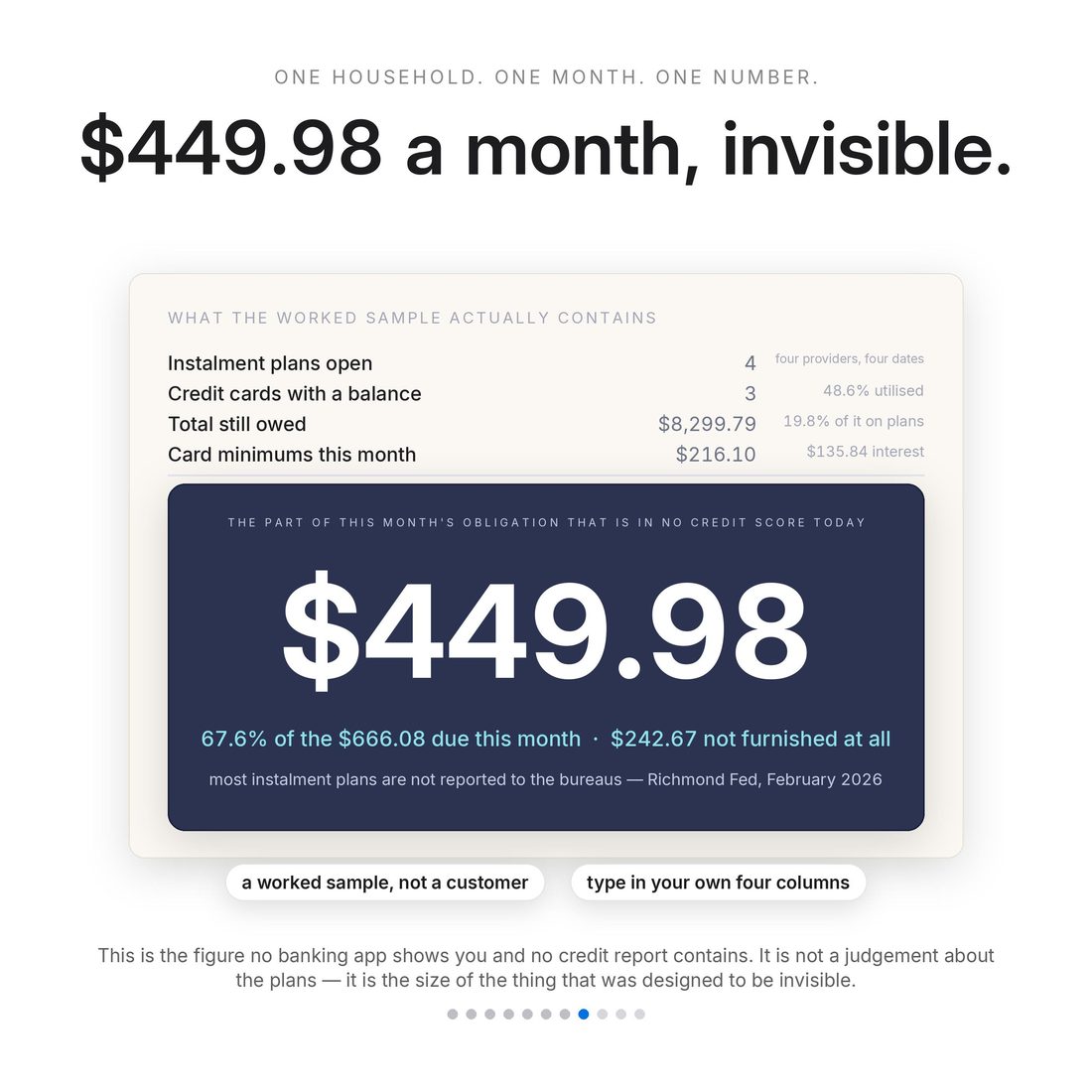
Four instalment plans do not show up on a credit report. They do not show up as a recurring line in a banking app. They do not feel like debt at checkout. What they show up as is a bank balance that is smaller than it should be on the third of the month, and nobody can say why. This 20-tab workbook is the inventory that makes them visible: every instalment plan, every card minimum and every fixed loan payment turned into one number, one calendar and one warning. In the worked sample the true monthly obligation is $666.08, of which $449.98 — sixty-seven point six percent, two thirds of everything leaving the account — is in no credit score today. On the same sample dates, $403.78 falls due across three days as four separate payments against one paycheck, and the projected balance bottoms out at $234.22.
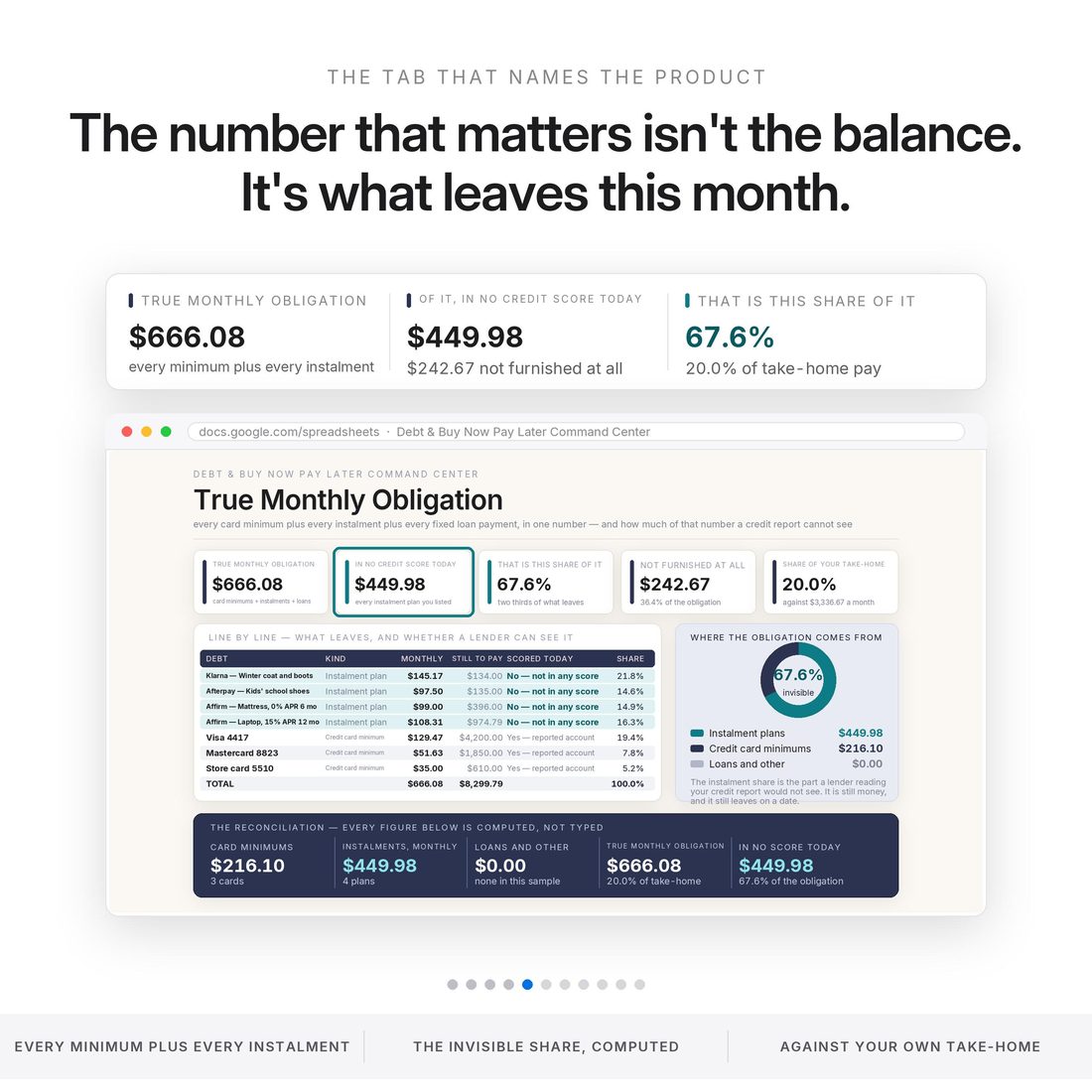
- True Monthly Obligation — every card minimum, instalment and fixed loan payment in one figure against your own take-home pay; $666.08 a month in the worked sample
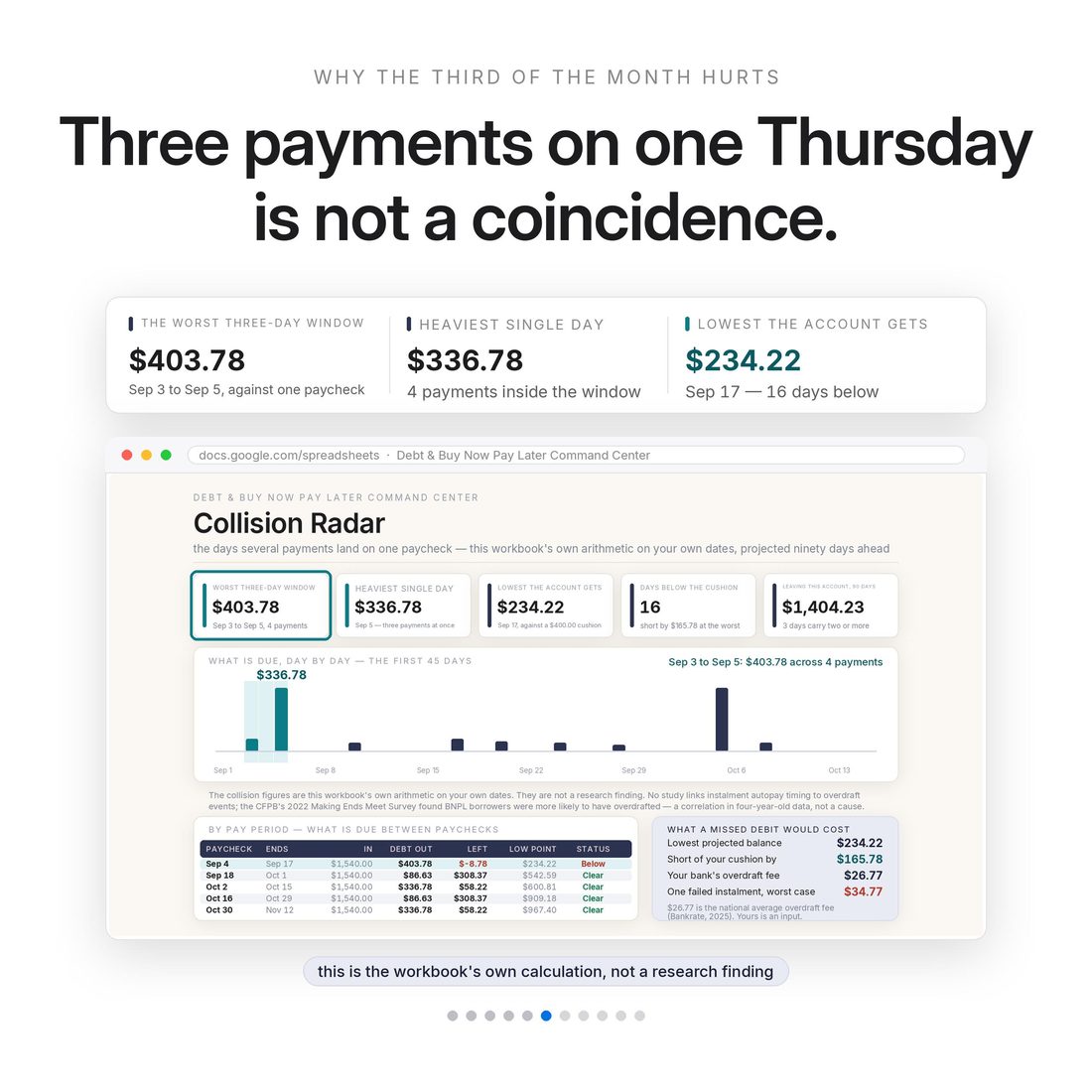
- Collision Radar — your own dates on a real ninety-day calendar with the worst three-day window found for you: $403.78 across three days, four payments against one paycheck
- The Invisible Share — how much of this month's obligation sits in no credit score today; $449.98 in the sample, sixty-seven point six percent
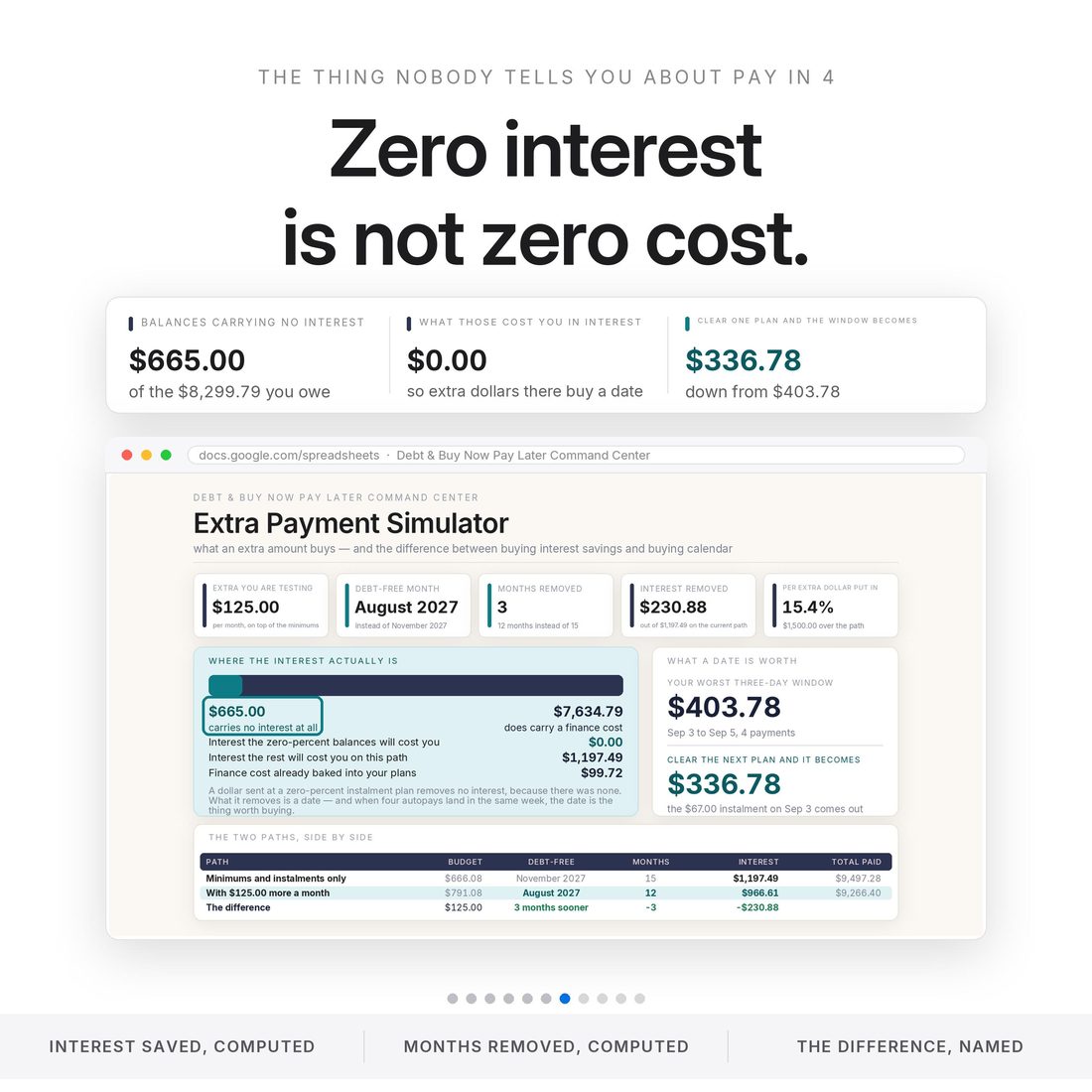
- Extra Payment Simulator — what an extra amount buys, and the difference between buying interest savings and buying calendar
- Know Your Rights — what is verified and what is not, every line dated and sourced, including the contradiction this file cites rather than resolves
Overview
Your credit report can't see them. That's why you can't either.
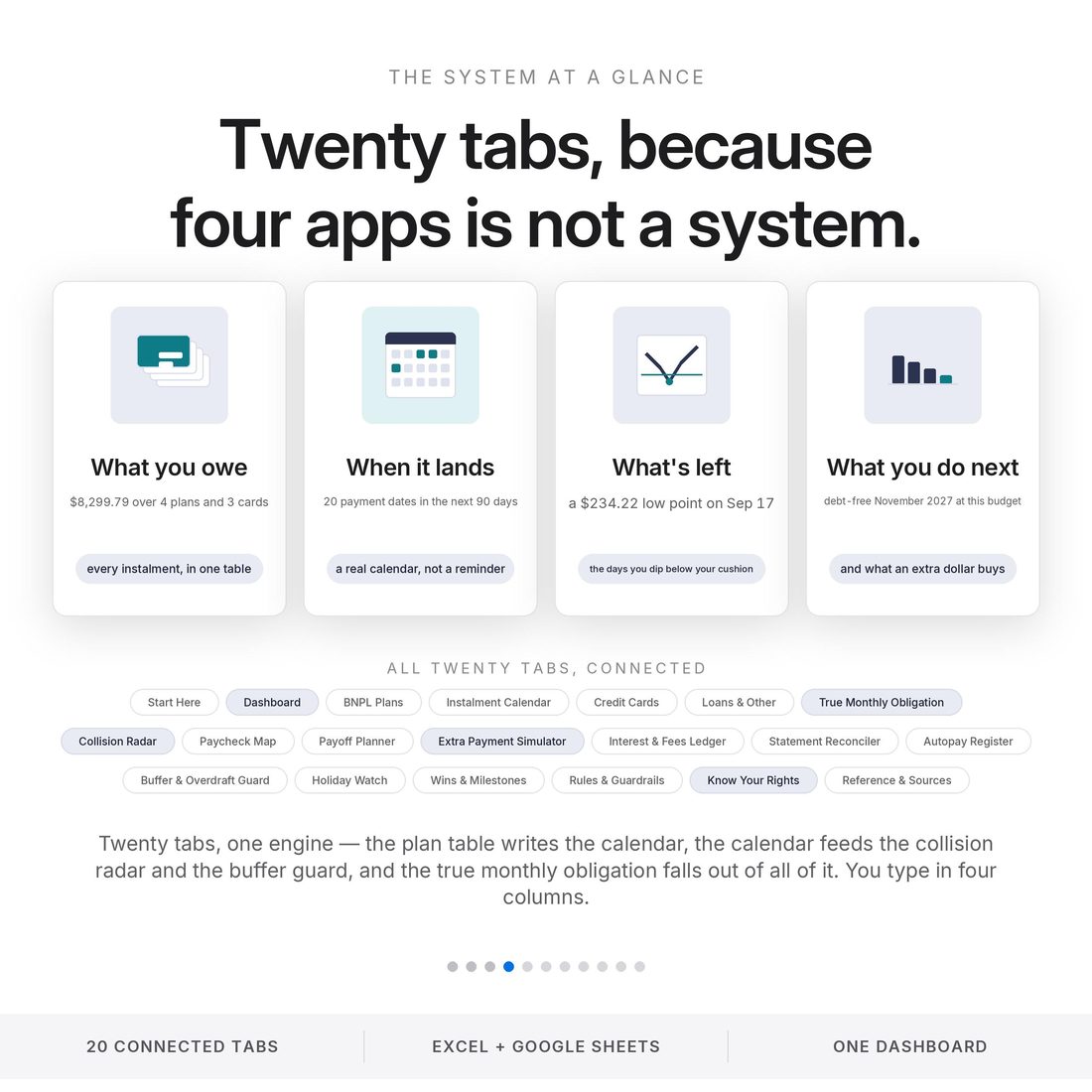
Four instalment plans do not show up on a credit report. They do not show up as a recurring line in a banking app. They do not feel like debt at checkout. What they show up as is a bank balance that is smaller than it should be on the third of the month, and nobody can say why. This 20-tab workbook is the inventory that makes them visible: every instalment plan, every card minimum and every fixed loan payment turned into one number, one calendar and one warning. In the worked sample the true monthly obligation is $666.08, of which $449.98 — sixty-seven point six percent, two thirds of everything leaving the account — is in no credit score today. On the same sample dates, $403.78 falls due across three days as four separate payments against one paycheck, and the projected balance bottoms out at $234.22.
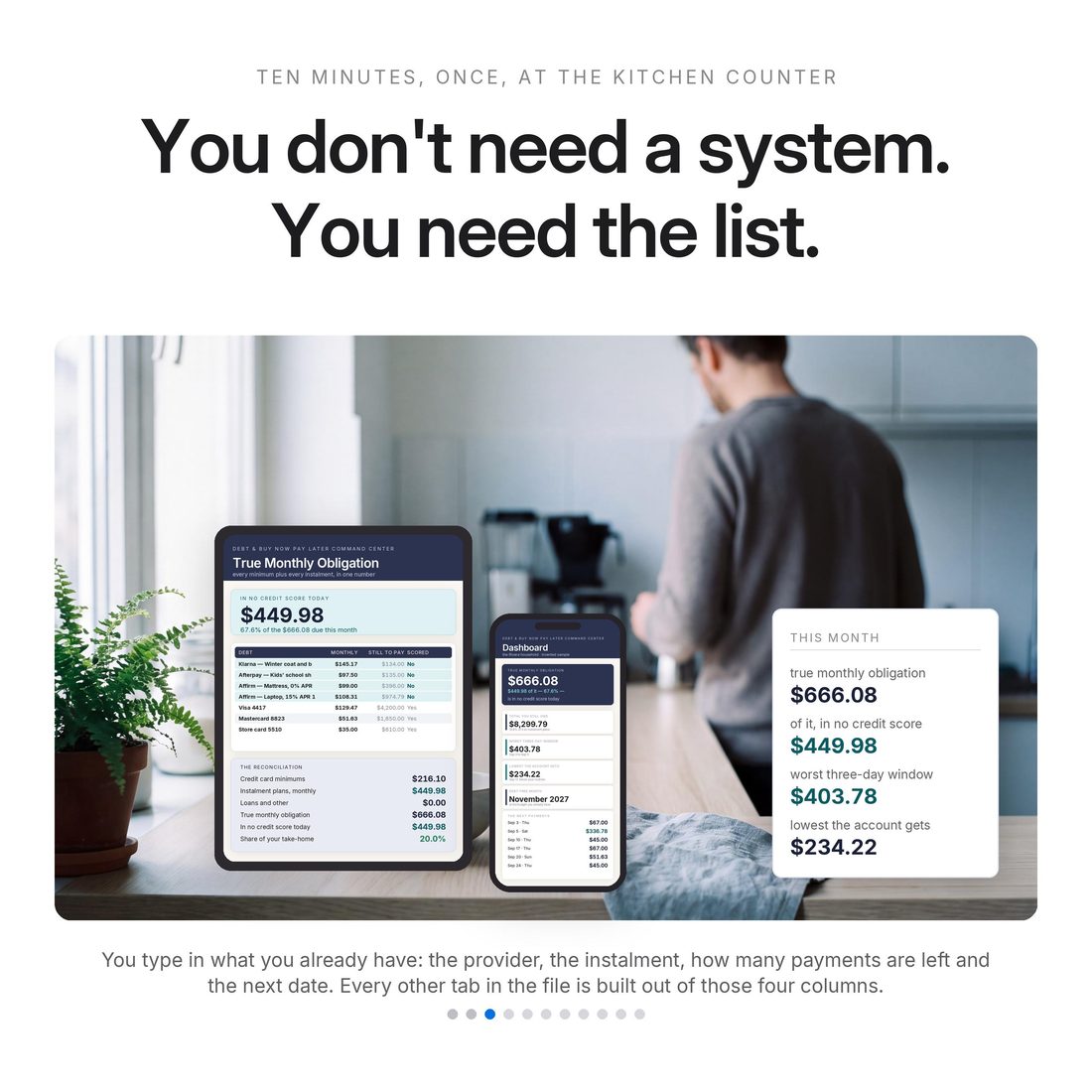
You type four things per plan: the provider, the instalment amount, how many instalments are left, and the next date. Cards want the balance, the limit, the APR and the due date. Everything else on all twenty tabs builds itself out of those. Input cells are cream with brown text and calculated cells are white, so you can always tell at a glance what you may type in.
What's Included
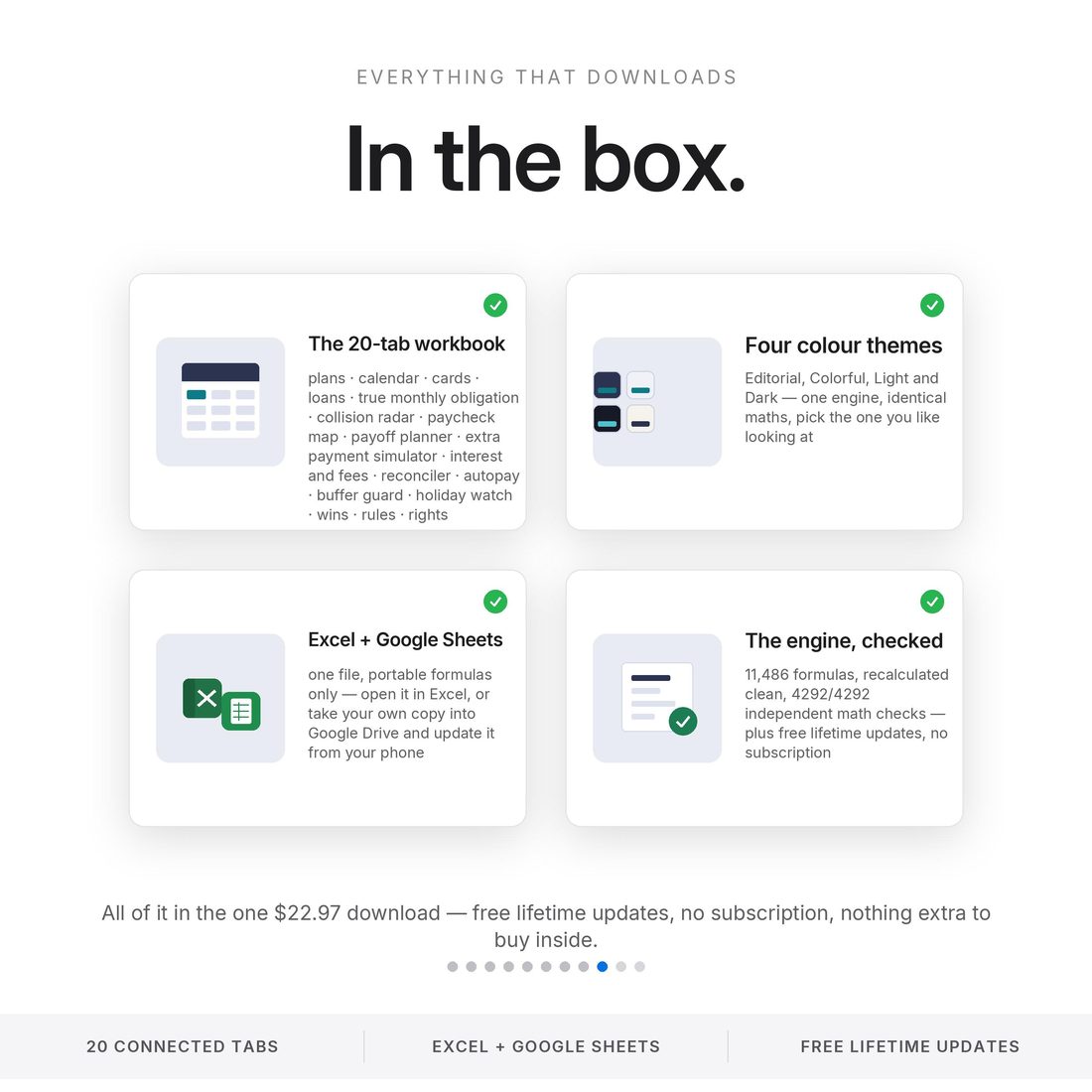
20 connected tabs:
- Four full themes — Editorial, Colorful, Light and Dark (.xlsx), the same complete engine in each
- Quick-Start-Guide.pdf — start to finish in minutes
- ACCESS-YOUR-TEMPLATE.pdf — one click opens your own copy in Google Sheets
- README and LICENSE — delivered as one ZIP, instant download
Key Benefits
Why this one
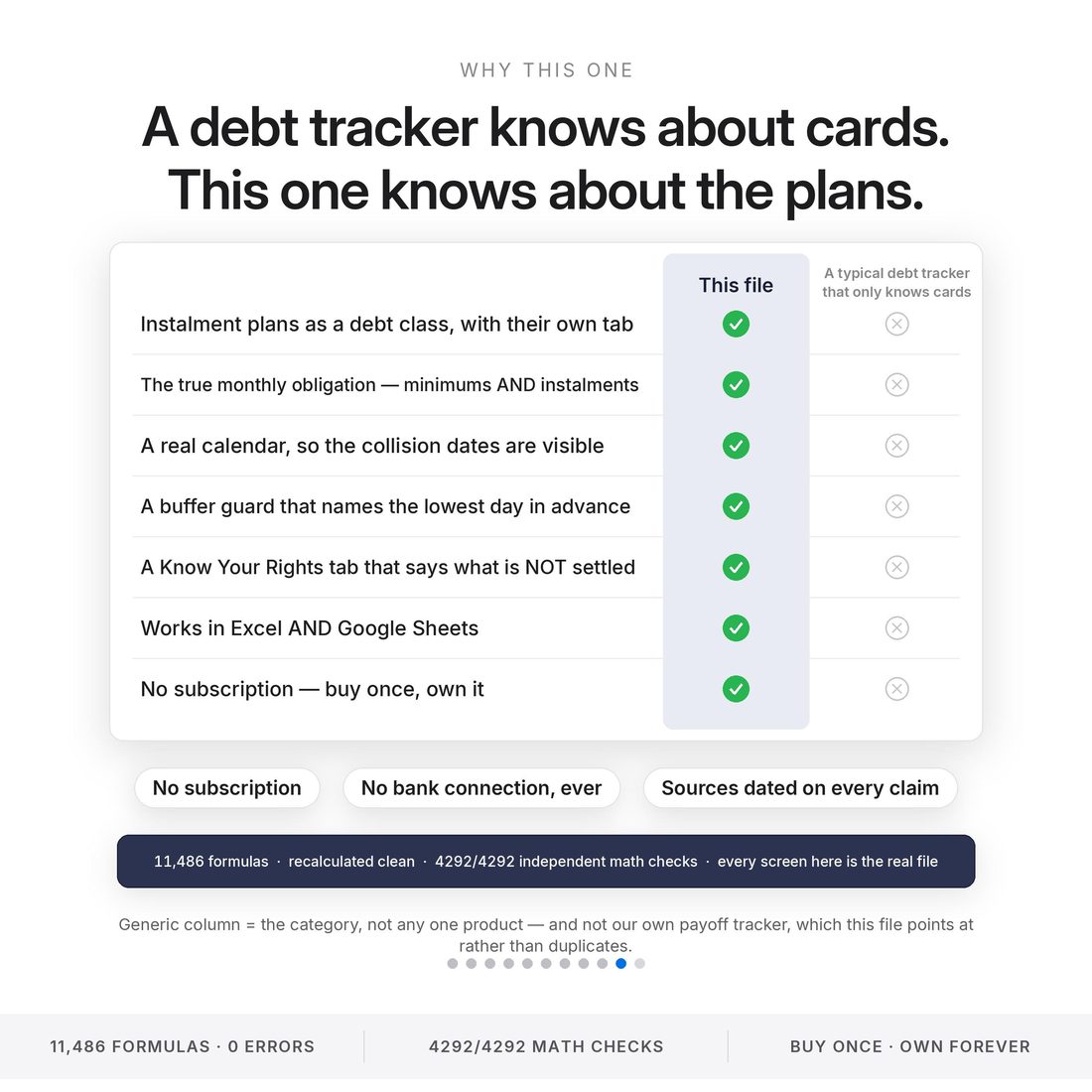
Every card minimum plus every instalment plus every fixed loan payment, in one figure, against your own take-home pay. $666.08 a month in the worked sample.
$449.98 of that obligation — sixty-seven point six percent — is in no credit score today. A lender reading your report would never see it, which is exactly why you could not either.
Your own dates on a real ninety-day calendar, worst window found for you: $403.78 across three days, four separate payments against one paycheck, and the projected balance bottoming out at $234.22.
The Extra Payment Simulator separates interest saved from calendar bought, so you can see which of the two you are actually paying for.
Know Your Rights carries the Richmond Fed's Economic Brief 26-05 of February 2026, FICO's blog of 12 March 2026, the Pay-in-4 interpretive rule withdrawn on 12 May 2025, and the Experian and Affirm statements that publicly contradict each other. Both are cited, dated, and neither is picked as the winner.
It never asks for a password, never connects to a bank or a provider, and never sends anything anywhere. The whole problem is that this information lives in four apps you do not control; the fix is a file you do.
Who It's For
Built for
- Anyone running more than one instalment plan with no single figure for what they cost each month
- People whose account is quietly smaller on the third of the month and cannot say why
- Anyone about to apply for credit who wants to know what a lender will and will not see
- Households juggling card minimums, Pay-in-4 plans and a fixed loan on four different dates
How It Works
Up and running in minutes
A hosted Google Sheets copy link is included, so you can start in one click. Portable formulas only, so both engines agree on every figure
Provider, instalment amount, how many instalments are left, and the next date
Balance, limit, APR and due date for each card; auto, personal, medical payment plans and family loans alongside
One monthly figure, the invisible share, the worst three-day window, and the day the balance bottoms out
Rules & Guardrails holds your household's own written rules with a weekly log, and Wins & Milestones dates every plan's end and the monthly amount it gives back
Why It's Different
Not another template
A payoff tracker answers what you owe in total. It cannot tell you what leaves the account this month, which days three payments land on one paycheck, or how much of the obligation a lender reading your credit report would never see. This file does those three things first and points at the deeper payoff toolkits rather than duplicating them.
Delivery & Compatibility
Instant, and works with what you use
As soon as your order is complete you get instant access to download your files. Prefer Google Sheets for real-time updates and dropdowns? It's fully optimized. More comfortable in Excel? It works just as well.
Built and tested in the latest Excel (Office 365). On Mac we recommend the Google Sheets version — the template is not compatible with Apple Numbers. Available in English. The template ships with sample data so every screen works on open; clear it whenever you're ready. The images and video show that sample data to demonstrate how it looks in use.
FAQ
Questions, answered
Does it work in Google Sheets?
Yes — one click. A hosted Google Sheets copy link is included with your download, and the same workbook opens in Microsoft Excel. Portable formulas only, so both agree on every figure.
How much do I have to type?
Four things per plan: the provider, the instalment amount, how many instalments are left, and the next date. Cards want the balance, the limit, the APR and the due date. Everything else on all twenty tabs builds itself out of those. Ten minutes, once.
Will this repair my credit or report my plans?
No. It is a record-keeping and arithmetic tool — not a credit repair service, and not a substitute for the terms of your own agreements. Know Your Rights sets out what is verified, what is not, and the date each was checked.
Does it connect to my bank or my providers?
Never. It has no login, never asks for a password, and never sends anything anywhere. Nothing you type leaves the file.
Is anything pre-loaded?
Yes — an invented household ships inside: four plans, three cards, $8,299.79 owed, and a $666.08 monthly obligation of which $449.98 is in no credit score today. It is not a customer and not a case study. Delete the sample rows and every figure on every tab redraws itself around yours.
Can I get a refund on a digital download?
Because delivery is instant, all sales are final — but message us with any issue and we'll make it right.
A record-keeping and arithmetic tool. Not financial, legal or tax advice, not a credit repair service, and not a substitute for the terms of your own agreements. The collision figures are this workbook's own calculation on your own dates — no study links instalment autopay timing to overdraft events, and the file says so on the tab. The figures shown are a worked sample, not a customer. Sources cited and dated in the file include the Federal Reserve Bank of Richmond (Economic Brief 26-05, February 2026), FICO, Experian, Affirm, and the FTC advance-fee rule at 16 CFR 310.4(a)(5). For personal use only. © 2026 NicheToolkitHub — no resale or redistribution.